The Paquedad of Paco
By Natalia Plumaverde (pseudonym) · Colombia, Medellín · Yellow-crowned amazon (Amazona ochrocephala)
This story is chapter V of The Spirit of the Parrots.
Since I was a girl, parrots have been my favorite animal. I always told my mother I wanted a little parrot — my green angel — to be my best friend and companion.
The right moments arrive at the right time. The special beings who enter your life have a wondrous and miraculous way of finding you.
Semana Santa had just passed. My mother was opening her eyewear and hat shop, which sat on the main commercial street of our town.
She tells me that a man walked into the shop carrying a cardboard box. He offered her a parrot — said it had a damaged wing and had to be fed with a spoon.
My mother, ever the negotiator, told him she'd trade him a pair of glasses but pay him in cash for the parrot. The man accepted. Afterward, he admitted that no one had wanted a parrot in that condition.
It was 8 in the morning. That day I had gotten out of bed with a feeling that something good was coming. I always look up at the sky and say to God: "I'm ready for your wonderful surprises."
My wonderful surprise would arrive in the form of a cardboard box with a hole in it.
My mother walked toward me carrying the second-best gift she has ever given me — the first being my life, and the second being what was inside that small box.
When I opened it, the most beautiful eyes I had ever seen looked back at me: small orange eyes, bright green feathers.
It was the first time I discovered you can cry from happiness.
I lifted him out of the box. I saw that his wing was damaged. I knew this was my first real responsibility in life — I would be his child-mother, because I had to feed him with a little spoon.
As a girl, I had trouble pronouncing the letter R. So I told my parrot: I can't give you a name with an R in it, because my brothers will laugh at me when I call you. You'll be called PACO.
I held out my hand and Paco climbed onto it. We loved each other from the very first day we met.
They say that when you truly love someone, nothing feels like a sacrifice — because everything you give comes from the heart. I stopped going to play at my friends' houses, because I had a schedule: make Paco his puree and feed it to him with a little spoon.
When Paco was taken from his habitat, he most likely had a fall — which is why his beak and wing were injured.
Over time, Paco's beak healed, but his wing stayed drooped. He loved sunflower seeds. I'd buy them to him whole, pod and all, and he was an expert at getting them out of the shell.
Years passed, I got married, and I took my friend Paco with me.
From the moment he met my boyfriend, Paco wanted nothing to do with him. Every time he managed to get hold of him, he'd bite.
Animals have a gift we humans haven't developed. They see past faces and appearances.
Even so, I ignored my green angel — though everything has its reason.
A few years into my marriage, I went to see my gynecologist. She told me I wouldn't be able to have children.
That afternoon I came home sad. The moment I opened the door, Paco threw himself off his perch, walked toward me on his crooked little legs, climbed up my pants using his beak, and made it to my shoulder.
I was usually the one who preened him. When I said the word "piojitos," he would lower his head onto my shoulder, fluff up his little feathers, close his eyes, and let himself go in the warmth of my hands.
Paco called me his Nata. That day he called me his Nata, and as if he could feel my grief, he ran his beak gently through my hair.
I told him: friend Paco, I don't think you'll have a little sibling. What if you keep me company at the nativity scene and we ask the Christ child for a baby?
My green angel helped me pray with such faith that two months later I was pregnant.
That day I came home happy, shouting: "we're having a baby." Paco laughed and sang: "patojito real, visto de verde y soy liberal."
The day my baby was born and I arrived home with him, Paco threw himself off his perch, climbed up my dress, and from my shoulder looked at the baby with great curiosity. I told him: Paco, now you have someone to look after too.
He took those words to heart — because whenever the baby cried, he would tell me: Nata, the baby.
Time passed. One night I became a victim of domestic violence. That night I waited until the abuser was asleep, took my little boy in my arms, and walked out of that house.
I was crying because I had to leave Paco behind. I knew that if he saw me, he would start making noise.
In my mind there was one word: "I'll come back for you."
I went back many times to try to get him, but my ex-partner refused out of spite. His words were always the same: sign over full custody of the boy and I'll give you the parrot.
From the doorway I shouted to my Paco: "you know I love you. When my boy is with you, you will be his green angel."
The people who want to hurt us often separate us from the beings they know we love.
I had been separated from my Paco. Then one day the father of my son, using a custody visit arrangement, decided not to return my son to me.
He left the city. I had no news of my son for more than a year.
It is the greatest pain I have ever experienced. During that time I could feel my soul tearing apart. I would look at his small clothes in his drawer, his bed, his favorite toy. It marked my soul.
One night, after crying and living under a deep depression, I dreamed that Paco said to me: "my dear mother, we will be together again."
You are never alone. GOD sends people to help us.
He sent me a lawyer named Mónica Ramos — a woman who was not only a professional but a deeply human one. When she learned my case, she did everything possible to help me get my son back.
Justice was finally served: a family court judge ordered the father to return my son to me.
After one year, four months, and 6 hours, I would have my beloved son back.
I had my house decorated for a celebration — balloons, cake, and a giant banner for my son.
When my son arrived, he hugged me and said: "madre mía, I missed you so much."
He had never called me madre mía before. He always called me mamá.
I told him: that's what PACO called me in a dream.
He answered: you know, madre mía, Paco took care of me. We played Lego — he would carry the pieces in his beak. He was my dragon from the Lego castle.
Mamá, because of Paco we're together again. He did the paquedad.
I hugged him and asked: what is paquedad?
He answered with a beautiful light in his eyes: mamá, PAQUEDAD is FREEDOM.
My little boy sat in my lap and said: before I came, a woman who visited my dad's house said she was a social worker. He and my grandmother were telling me I had to say you were bad, that you hit me.
When Paco heard that, he'd throw himself off his perch and bite both of them.
I would take him in my hands, and before putting him back on his perch, I would whisper in his ear: "I know you don't want me to tell those lies, and I won't."
Because I didn't tell lies, I am free to be with you.
I was completely stunned. I had always called Paco my friend, my green angel, my guardian.
I had cried at night because he had stayed in that house — but the reason was this: that was the mission his soul had chosen.
His great mission in my life and in my son's life was to do the PAQUEDAD — that freedom we all deserve.
My son didn't feel free because he was separated from his mother. I wasn't free because I was a prisoner of the pain of being separated from him. Paco wasn't free.
As I sat with that thought, a wind came into my room — though no window was open. For one second I felt in my own chest what Paco felt: the confinement, the drooped wing, the longing to fly. It lasted only a second, but it was enough.
That night I talked with my boy. I told him the right thing was for us to give Paco his paquedad — to give him his freedom.
I explained what a parrot's natural habitat is. I helped him reflect on what we had both felt when we were separated and not free.
With love I told my boy: you know that Paco was in a palm tree, happy with his mother, and some people took him away from her — and even hurt his wing.
I had found a place where he could live free. He'll be with other parrots and might even have young of his own.
My son answered, happy: "let's do plan paquedad for Paco."
I gave him instructions: on the weekend he was at his father's house, he should say goodbye to Paco, because at some point people who protect wild animals would come, take him, and set him FREE.
The great weekend of paquedad arrived. I had already coordinated everything with animal rescue and asked to be present to support my son emotionally.
The boy's grandmother was the one looking after him at his father's house. She didn't like PACO, and he didn't like her. She hadn't given him away only because she knew Simón liked going to his father's to play with PACO.
Some elderly women have sharp ears. When Simón held his little parrot in his hands to say goodbye, he told him: thank you, friend Paco, for the paquedad. Because of you I'm back with my mamá.
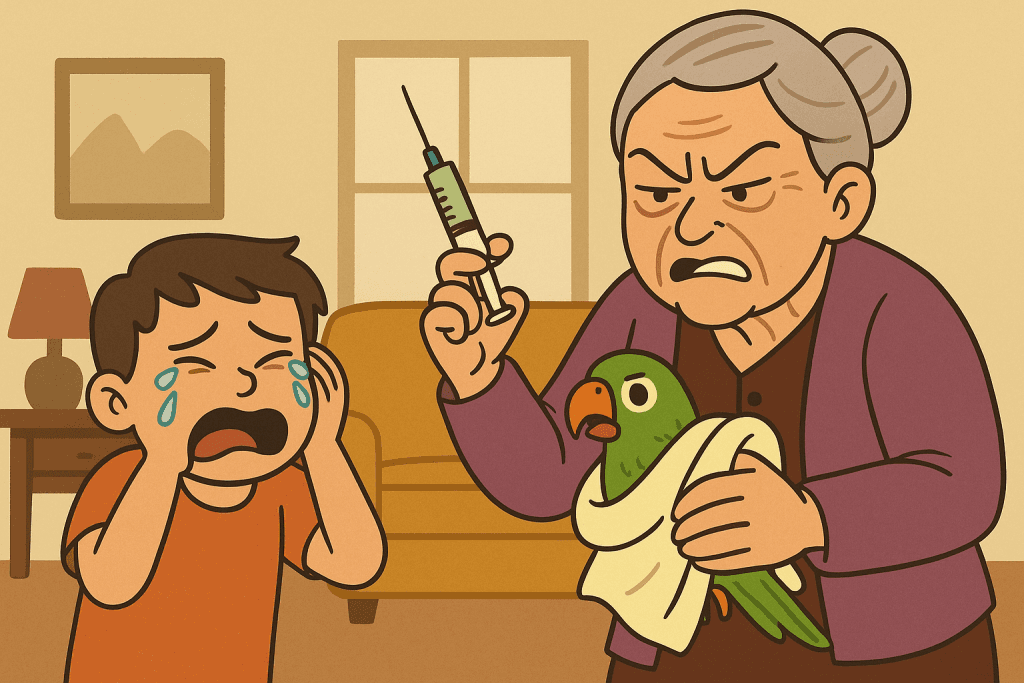
The woman grabbed a syringe, filled it with poison, picked up a towel, and seized Paco by force in front of the boy.
While Simón cried trying to save his friend, she shouted: "for helping that woman, I'm going to give you your freedom right now — the freedom of death."
She ignored her grandson's pleas and Paco's fight for his life — he was biting back, struggling to survive.
When the neighbors heard a child crying and screaming "don't kill him, don't kill him," they gathered around the house.
What the woman didn't know is that parrots have a guardian angel too. At that very moment, animal protection was arriving at the house. The police broke down the door and caught the woman in the act.
The animal rescue team examined Paco and he was all right. I hugged my son and held him. Simón wanted to hold his friend, who was shaking with fear — to hold him and calm him down.
I also asked that he be allowed to follow Paco's process, to know for himself that he was really okay.
After witnessing a scene like that, I took my son to therapy sessions, where he drew Paco and wrote a letter to his friend, the little talker.
Every year I celebrate with my boy the anniversary we call "LA PAQUEDAD."
We dress in green in honor of our green light guardian.
We honor our freedom and the freedom of our beloved little parrot.
Together we paint a picture of Paco flying free in a forest, with sunflower seeds — his favorite food — and a universe full of stars so he can fly as high as the stars themselves.
I want to celebrate paquedad with my boy at the Foundation, and take him to see pacos, as he calls them.
Even though we both love parrots, we came to understand that no one deserves to live in captivity. You love in freedom.
We all deserve PAQUEDAD.
Notice: Names, identities, and certain details have been changed or substituted to protect the privacy of the people mentioned. In addition, some passages have been partially or entirely fictionalized; this account may therefore contain elements of fantasy.
Analysis and reflections from Fundación Loros
The episode of Paco's rescue captures the full weight of this story: after so many losses and reunions, the parrot's life ends up protected in the hands of environmental authorities. That arrival — police forcing the door open, a rescue team examining the bird and securing his transfer to a semi-free habitat — confirms that freedom can and must be built through collective responsibility. This is not only a legal victory: it is the first time Paco stops being a hostage to human vengeance and becomes a subject of rights.
Throughout the story, the human-animal bond holds firm. Paco senses the author's sadness, shields her from deception, defends Simón with bites, and ultimately inspires mother and son to practice "paquedad": to love in freedom. That complicity proves that empathy knows no species — it is a bridge strengthened by everyday gestures — a "piojitos", a Lego piece held in the beak — and it reaches its peak when the boy embraces the trembling bird after the attempted killing.
Paco's transfer by professionals embodies hope: the family healed its own story by giving him over to a fitting habitat, and he, with his broken wing but his spirit intact, becomes a symbol that caring also means knowing when to let go.