My dad is not a macaw
By Yeraldilsa Gamboa Suárez · Colombia, Santander · Scarlet macaw (Ara macao)
This story is chapter X of The Spirit of the Parrots.
My dad is not a macaw… he doesn't cross the skies in brilliant colors… he doesn't spread his wings to kiss the air. My dad is just a farmer from Santander who one day was captured and put in a cage; this is his story.
Alberto, my dad, was a community leader in a village in a municipality as magical as the mist that descended gently and wrapped itself around the mountains. The door of our house was knocked on July 20, 2003, at around 3 AM. My uncle Osvaldo and don Segundo were inviting him to "drive out the guerrillas," and he left — ignoring my 11-year-old brother's pleas.
They say that once you've gone to bed, no matter who knocks, you shouldn't open the door… That early morning, my dad and his companions accidentally shot a neighbor from the village. Their urge to take justice into their own hands set off a new conflict that would land them in prison and, later, force them to flee to escape revenge… revenge that sought death.
Violence in Colombia is nothing but the flaring up of grievances that, as Germán Castro Caycedo would say, don't belong to us. We are witnesses to a war that is not ours, yet it has made us its own — cruelly and mercilessly.
One day, many years later, Fernanda arrived — a macaw who, after living in captivity, was rescued by the Corporación Autónoma de Santander and released in the rural area of the municipality of La Paz. From a distance her colors stood out among the trees: the intensity of the oranges and reds, a touch of yellow, and the balance of a deep petroleum blue. She was, without question, the largest and most striking bird I had ever seen in my life.
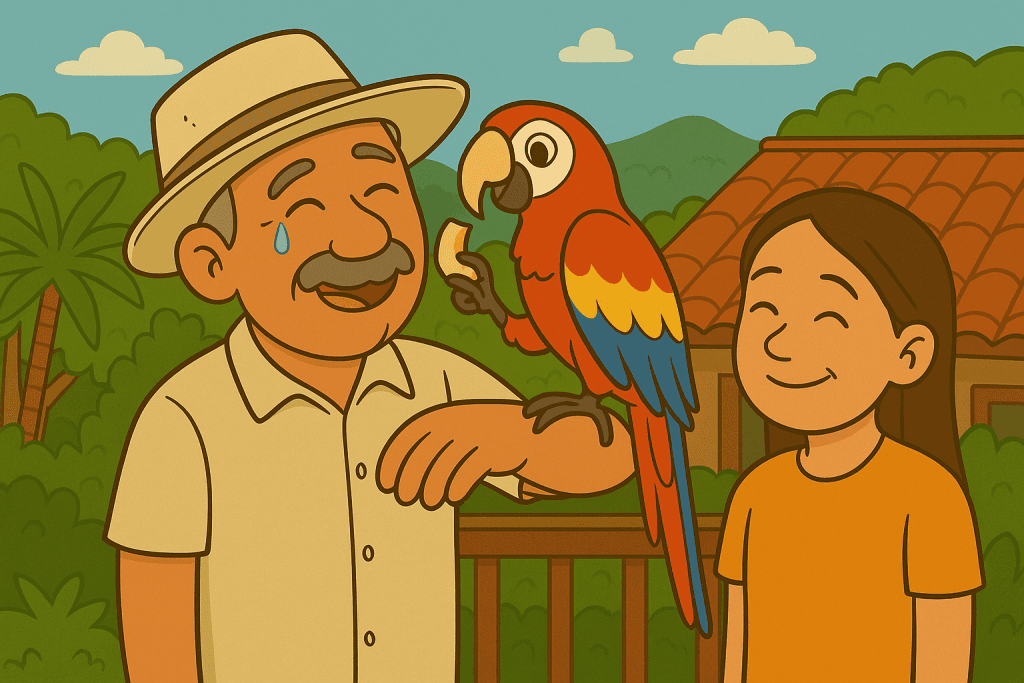
I grabbed my camera and saved her in a small corner of my photographic memory and my heart. She gave me a beautiful image: she landed on my dad's arm, calmly, to eat banana, while he smiled and watched her.
It may have been coincidence, but it reminded us how precious freedom is — and the right that all birds, all animals, have to always be free. If a person, even one who has made mistakes, sees prison as the worst punishment, how can it be that humans treat it as ordinary to condemn an animal to the same fate? Fernanda came to tell us that violence is not only the cruel and vile armed conflict, but every act that strips a living being of its freedom and its right to inhabit the natural world.
I don't know where it came from: the midday air was still, not a leaf stirred, and yet a brief wind came down through the trees and brushed against my dad. He closed his eyes for barely a second, as if he suddenly felt an old hunger for sky that was not his own… or was.
Without a word being spoken, I understood how my dad saw himself reflected in Fernanda's eyes… how he wished that no one would ever stop her wings or her flight again. He didn't tell me that himself; the tears on his cheeks told me — when that macaw resumed her journey and disappeared among the trees.
Analysis and reflections from Fundación Loros
When Fernanda, the rehabilitated macaw, perched on Alberto's arm, the scene was enough to highlight a contrast: a bird reclaiming its flight alongside a man who knew confinement through an armed conflict conviction. Watching them, the question surfaces without drama:
"If a person, even after making mistakes, sees prison as the worst punishment, why do we normalize the same sentence for a wild animal?"
The reflection is direct. Caging a parrot, even with good intentions, replicates the punitive logic we reject when it falls on humans. The process that took Fernanda from a cage to the forest points to a more coherent path: rescue, rehabilitate, release. The goal is not to provide domestic entertainment, but to restore the ecological function and autonomy of the species.
In the end, Fernanda takes flight and disappears into the yarumos. No heightened emotion is needed to reach the conclusion: respecting the freedom of other beings is part of an ethic that, applied in time, keeps us from repeating with wildlife the mistakes we have made with each other.