There is always hope
By Jennifer Acosta Martínez · Colombia, Barranquilla · Brown-throated parakeet (Eupsittula pertinax)
It all started in the busy center of Barranquilla. The noise of engines, the overlapping voices of street vendors, the usual heat of the city — all of it ordinary… but that day, somewhere in all that chaos, I heard a very soft chirping. Like a whisper among the concrete. I walked closer, and there she was. A small parrot with sad eyes, sadder than anything I had ever seen.
She wasn't flying. She barely moved. They told me they had her drugged so she wouldn't escape. That it made her easier to sell. And I knew I had to do something. So I bought her — not to keep her, but to free her.
I took her home and named her Anahi. The first few days were hard. She didn't sing, didn't fly, didn't look at me. She barely breathed. But I knew she just needed time, care, and freedom.
I offered her fresh fruit, an open window, my words. She started to move her wings — at first like a shy gesture, like the memory of something she had forgotten. Little by little, as if recalling what it meant to be a bird, she stretched her wings toward freedom.
Watching her joy come back was a gift I hadn't asked for, but that life gave me anyway. One day, without warning, she flew inside my house. Not far. Just a few meters. But enough for my heart to know: she was ready.
The first time I saw her fly, it felt so full of meaning that I understood the moment had come to be free. Anahi no longer needed me — or rather, she didn't need me to keep her enclosed.
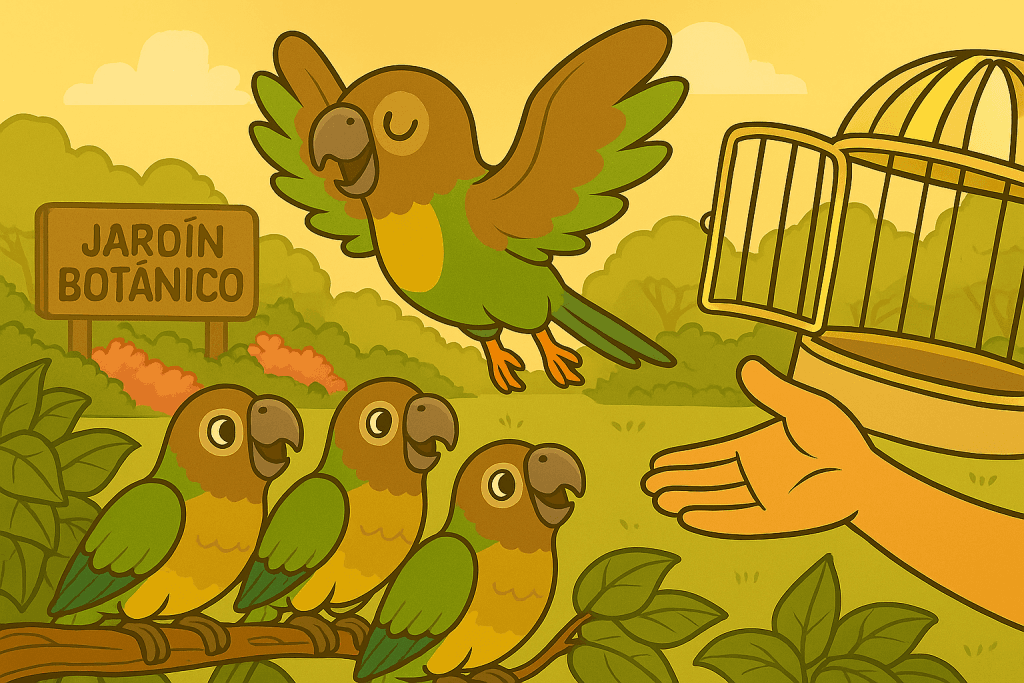
I took her to the Jardín Botánico de Barranquilla, a place full of tall trees and the murmur of other birds. I opened the cage. She hesitated. She looked at me. Then she took flight. She rose into the branches and disappeared among the singing. Hearing birdsong in the distance… my little parrot Anahi deserved the same. And she had found it.
That day, in the middle of a mix of sadness, pride, and something I still can't name, I understood that there is always hope. That even the most fragile things can heal. That being part of that process is one of the most beautiful gifts you can live.
Anahi is no longer with me, but her flight stays with me.
The joy of knowing I was part of that process.
There is always hope.
Analysis and reflections from Fundación Loros
The heart of this story beats with genuine compassion. Jennifer, with courage and tenderness, gave Anahi a new chance to fly. Her gesture comes from love, and that is deeply valuable. At the same time, her experience invites all of us to learn how to support that freedom well — with preparation, knowledge, and a deep respect for what it means to become a bird again.
Let's speak out firmly against every form of abuse: from those who drug, paint, or mutilate birds to sell them, to those who traffic wildlife illegally or keep them in degrading conditions. Silence perpetuates the harm.
It's also important to recognize that releases require far more than opening a cage: they depend on rehabilitation processes, flight-skill development, a suitable environment, the presence of other flocks, and ongoing support and monitoring, among other things.
Let's keep learning so we can defend, protect, and accompany our winged friends with tenderness and responsibility.
There is always hope.