Wings toward reunion
By Steban Telles Ospina · Colombia, Quindío · Yellow-crowned amazon (Amazona ochrocephala)
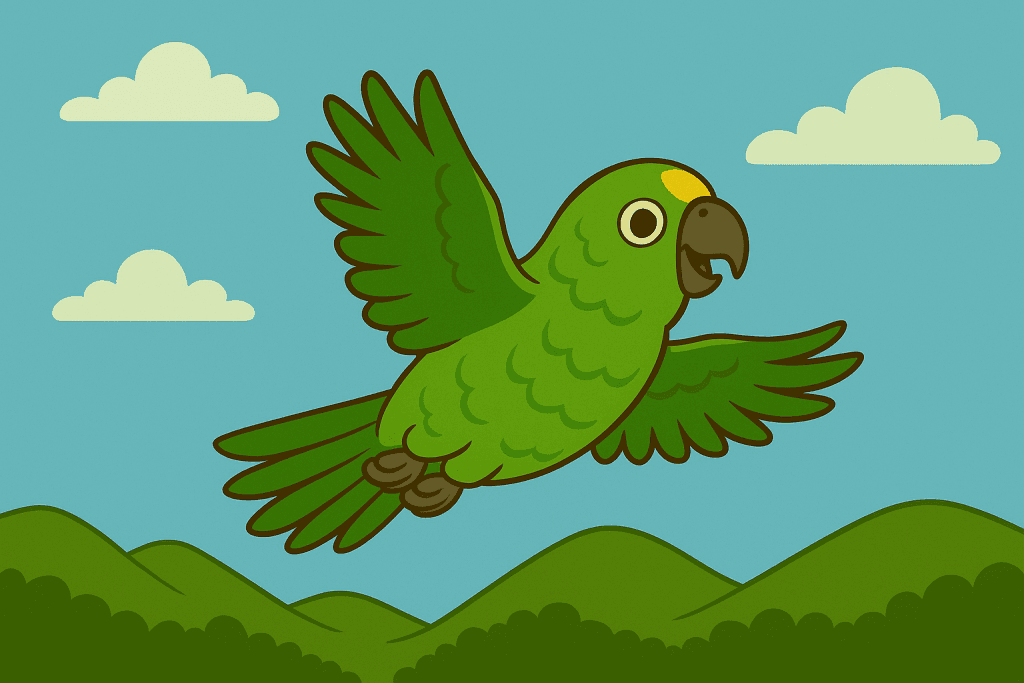
From a young age, I was always drawn to animals — I grew up surrounded by them. At home we always had dogs and cats, but when I visited my grandmother Amparo's farm, something shifted. In that small but remarkable house, my grandmother talked every day with a parrot named Martha: a striking forest-green bird with yellow tones that recalled the sun. My grandmother never tired of talking with her. She let Martha roam freely across the whole farm, and — without anyone understanding why — Martha never left, even though she always had the chance to fly away. It seemed Martha genuinely enjoyed spending time with my grandmother. They complemented each other, and when anyone else arrived, the conversations became the most enjoyable in the whole family: laughter, chatter, and pure joy.
Martha had been part of the family for two years when my grandmother died of cancer. It was a loss that affected all of us, but especially that small singer. It was striking to watch her grieve too: she stopped talking, and in silence, she walked through every corner of the house, searching for her faithful companion who was no longer there. She spent several weeks like that, worrying everyone — she ate very little and barely seemed to enjoy being on the farm. Then, three months after my grandmother's death, something strange happened: Martha began, slowly, to come back to herself. She started talking with us again. Those lovely words returned, the ones that made anyone nearby smile. But none of us knew what would come next.
One day, while we were inside the house, Martha called out my grandmother's name. She said it so clearly — "Amparo" — that it shook the whole family. It was as unexpected as it was beautiful. Hours later, Martha began moving close to each person in turn: my mother, my father, my brother. Then, as if saying goodbye to everyone, she flew off the farm in an instant. It was the first time she had ever done it, and it happened so suddenly that no one could stop her. We watched Martha fade into a blue sky, carrying our memories of her and of my grandmother, leaving behind the home that had watched her grow — but where her best friend was no longer there to hold her. Not with a rope, but with the kind of love that had kept them together. In that moment we understood: Martha didn't leave her home. She moved to the sky to find her faithful companion — two souls, free, searching for each other again.
That whole experience with animals, and with Martha above all, led me to study what I had always dreamed of: Biology. There I found my purpose — to study for and on behalf of animal conservation, standing up for their freedom and their right to be respected. They are great beings with great stories, and many of those stories deserve to be told.
Thank you!
Analysis and reflections from Fundación Loros
Parrots can live up to eighty years, and their bond with a human is often so deep — even monogamous — that losing their companion sends them into profound grief. When "their human" dies, families often don't know how to care for the bird left behind. This situation is not a romantic quirk of captivity, but the tragic consequence of depriving a wild creature of its social world.
Real responsibility starts with professional guidance: specialized veterinarians and biologists can design a rehabilitation plan that includes proper nutrition, environmental enrichment, and — above all — reintegration with other parrots as soon as possible. Only then can we give these long-lived creatures the company, the space, and the freedom they need to fly again in health and joy.