The rescue of Roberta: toward free flight… and family
By Taniapao · Colombia,
This is a true story about a parrot named Roberto. He came into my life after I visited my uncle's house and saw how he was being kept: locked in a cage with clipped wings. I told my uncle to give him to me. He refused — but later showed up at my house and sold him to me. I bought him because, from the start, my plan was to help him recover and give him his freedom.
His process was hard. Getting him back into nature wasn't easy. We set a broomstick in a mamoncillo tree near the house so he could spend his days there. From that perch he could see us, and whenever I walked by with food he would launch himself, spin and circle, and eat every last bit. I didn't give him human food, of course — he was used to it, and teaching him to eat seeds and fruit took time — but we got there.
It was beautiful to watch his eyes change color with each new flavor, and seeing his face covered in food lifted my spirits. The parrot — who I later realized was a female, because she was completely in love with my husband — was fiercely jealous: she would go after every woman she saw him talking to. I just laughed and pulled her out of their hair while they said, "What a jealous bird!"
Roberta was learning to fly. She crashed into everything, chasing me around the farm, until one day she climbed to the top of the mamoncillo, let out a string of shrieks — as if to say, "here I come, somebody catch me!" — and launched herself into the air. She screamed and circled, showing us she could do it. We were overjoyed. Then Roberta landed in a tree further down, on the neighbor's farm, and I went to bring her back. That went on for several months while her wings healed.
Eventually she flew freely around the neighborhood. She followed me on my motorbike, and I had to carry her on my shoulder. When I didn't take her with me, she found me anyway. One day she showed up at my basketball practice — flew into the gym, spotted me, and forced me to carry her all the way home, not before chasing a few of my teammates to peck at their heads.
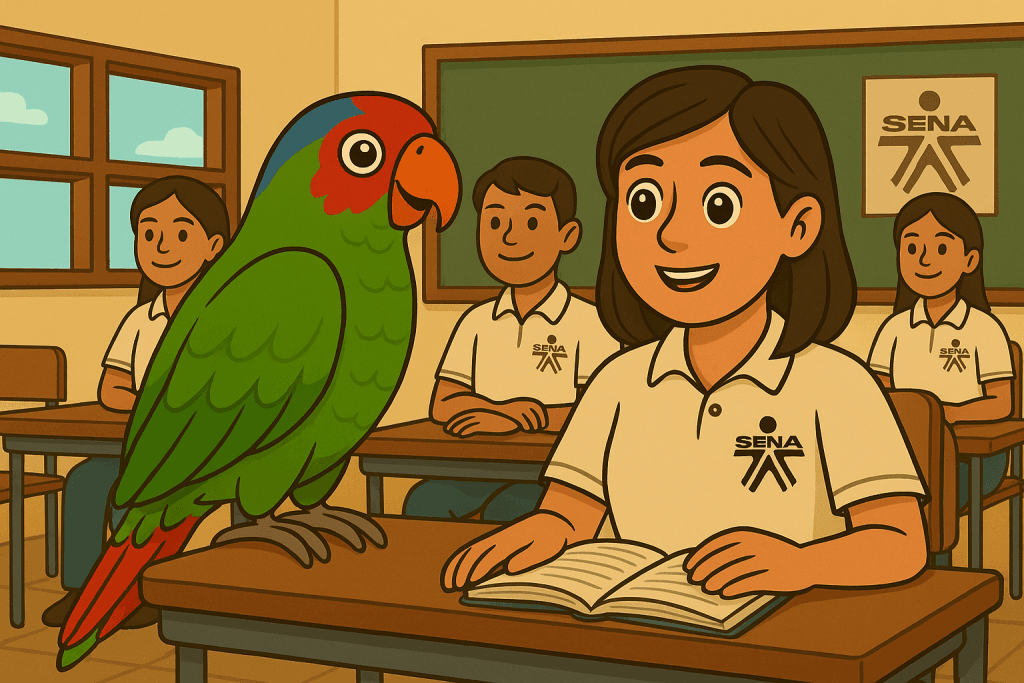
She also appeared at the SENA campus where I studied, shrieking. She came in through the roof, saw me, and I had to take her home. Sometimes I wasn't sure she'd come back: she would fly far off and I'd call her with a whistle — she'd return. But when she didn't, I knew someone had taken her. I rescued her four times. The last time involved the police, who already knew her and knew she was being rehabilitated. I told them her story and explained that the goal was to release her into the wild.
I remember that day clearly. I called my friend on the police force and told her someone had "stolen" Roberta — I knew where she was. She came quickly and helped me. We found that someone had clipped her wings again. I cried a lot. The process was slow, but with patience and love, she flew again.
In time we understood that letting her go was the right thing. Roberta made that choice herself: she started leaving and only came back to sleep. I prayed she was safe. The most extraordinary thing was watching her arrive, again and again, with a flock of her own kind — all of them beautiful and loud. It seemed like she was telling them about us, and about the food: she brought them to eat, and then they all left together.
She came back with a mate, and later with a chick. I cried when I saw what we had helped this extraordinary being become. She taught us to love and to fight for freedom. She built a family and came to show us she was well — maybe to say thank you.
Even though she was no longer with us, we knew she was happy with her flock. We learned that these animals should not be kept as pets. They deserve their freedom. What stays with us is her memory, and the quiet satisfaction of having respected what she chose to do with her free life.
Analysis and reflections from Fundación Loros
Roberta arrived at the farm as a rushed "rescue": clipped wings, an inadequate diet, and a cage that reproduced the very thing she was supposed to be fleeing. Even so, the gesture revealed an initial sensitivity: someone saw suffering and refused to be complicit in it. The real merit came later, when the family understood that saving doesn't mean possessing — it means restoring what was taken from those wings.
The release process was guided step by step. First, a "school perch" in the mamoncillo tree, where Roberta rebuilt muscle and relearned the motions of flight. Then a diet of seeds and fruit replaced the scraps of human food. Later, the open cage — reduced to a simple sleeping spot — meant that every outing was her own choice. That mutual trust transformed the relationship: the parrot went from jealous shadow to neighborhood explorer, and the family went from reluctant jailers to allies in her reintegration.
The defining moment came when she appeared with a flock, and later with a mate and a chick. Then the roles reversed: Roberta no longer needed care; she came back only to say hello and to remind them that freedom had been, in the end, the best gift any of them could give.