The dumb parakeet
By Jader Andres Hernandez Carrascal · Colombia, Montería · Orange-chinned parakeet (Brotogeris jugularis)
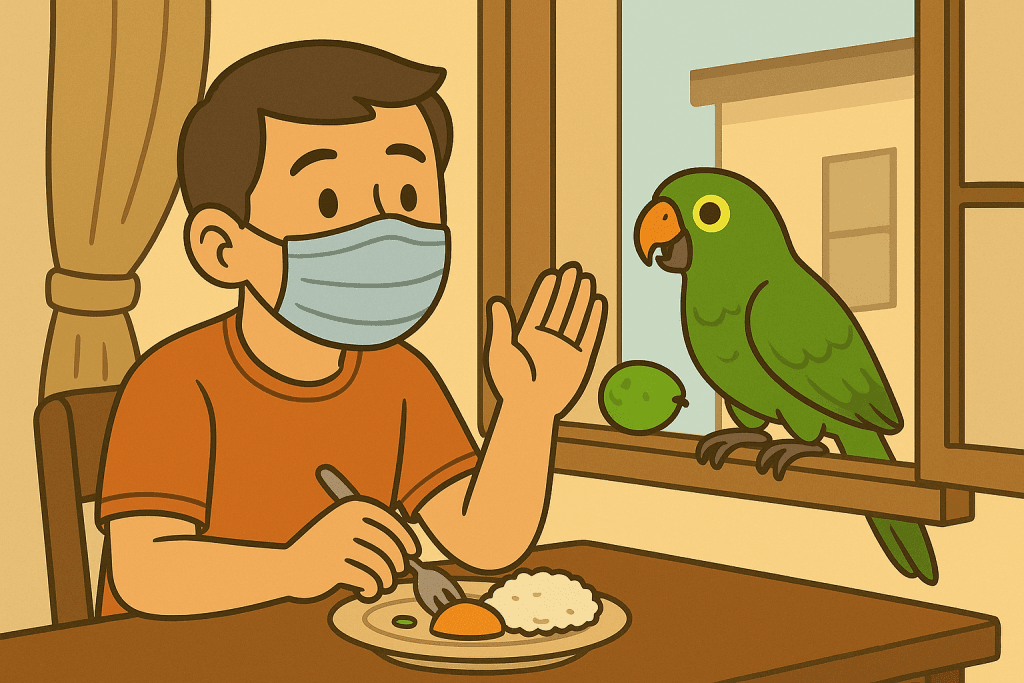
She arrived at my window at the start of the pandemic and, with her energy and sense of humor, kept me company for two years.
Her antics filled my life with joy… There were many mornings when she'd show up with something new and play dumb to get her way.
She'd climb onto the table and eat from my plate: she didn't like soup — ha! — but she loved fruit and rice.
We shared moments I won't forget. I still think about the time she stayed with me when I was sick, pecking at my nose and hair; I felt like she was urging me to keep going.
She was very smart: she'd warn me when someone came to the house, and she was jealous when it came to me.
She was, completely, a little rascal.
She didn't like baths — water scared her — but she loved having her head and back stroked.
Once she chased my brother when he was playing with me… I felt like she was doing it to protect me.
She came to look after me and give me strength during the pandemic.
For two years straight, we were the best of friends…
Until I decided to let her wings grow and stop being selfish with her, because I knew she was friends with other parakeets that came to the terrace in the evenings.
The day she left was hard, but inside I also felt joy watching her fly free with her friends.
I learned a lot from her: I became a more tolerant, more empathetic, and far more environmentally aware person.
Some days I feel like she comes by in the afternoon with her friends and starts making noise… but the little RASCAL won't let herself be seen.
Ha!
Analysis and reflections from Fundación Loros
When a bird comes through the window, it brings more than color and curiosity: it reminds us that freedom still exists outside our routines. Clipping its feathers to keep it close — even out of affection or loneliness — turns that spontaneous visit into captivity. The gesture cancels what we admire in the bird — its ability to fly, explore, and choose — and traps us too, inside the cage of possession.
Letting it stay free, on the other hand, redefines the relationship. The bird can return whenever it wants; its return becomes an act of trust, not an obligation. That voluntary choice teaches more than any guide to coexistence: it shows that genuine bonds hold without bars, and that respecting the natural cycle is the most honest form of care.
Every time a parakeet, a chickadee, or a hummingbird pokes its beak in, we have a chance to practice a simple ethic: observe, offer water or fruit if needed — and step back so it can fly when it's ready. In doing so, we remember that wings are for flying, and that, deep down, we too need air, space, and the chance to choose our own horizon.