Skip to content
Fundación Loros
The Sky of Cotorrín

The Sky of Cotorrín

By Sole · Colombia, Mosquera · Yellow-crowned amazon (Amazona ochrocephala)

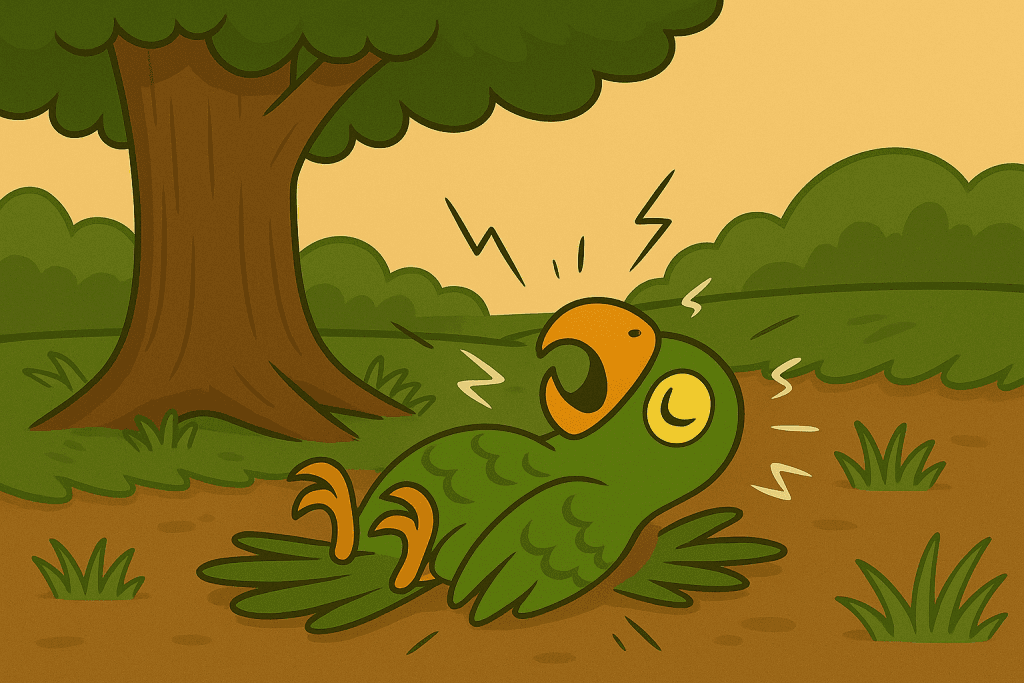
Cotorrín came into my life like a miracle wearing the shape of a wounded bird. A woman found him convulsing under a tree, his wings broken and one small leg bent. In that moment, I — Solexis, a fourteen-year-old girl — knew my life would take a different direction. I took him to the vet; frightened, he would hide inside my shirt every time we saw needles, but I never wavered. Through vitamin injections and medication for his seizures, Cotorrín — who had been called Kiara or Ricky before, but neither name fit him — gave me six years of unconditional love when the doctors had given him six months at most. Cotorrín was my son, my everything. He slept beside me and woke me every morning with a piercing "HEEELLO, MY LITTLE PARROT!" I showered him with affection, and he answered by spreading his wings whenever I sang him llanera music. He was so intelligent he could recognize vowels, do beatbox, compliment people, and — his beak smeared with lip gloss — cry like a baby when he was in pain. At every vet visit he pressed himself against my chest so they wouldn't inject him; his trust in me grew as strong as his will to survive. During those years, Cotorrín taught me that love can do anything. I learned to value each day as if it were the last: every breakfast together, every walk to the park where he would perch on my shoulder, every afternoon we spent shaking feathers in the breeze. He showed me the beauty of loving freely: I left birdseed and water out so he could feed the wild birds that visited the garden, and he reminded me that a real parrot should only ever live flying, not caged. When I had an accident and my grandmother cared for him, Cotorrín understood the importance of extended family: he accepted affection from his great-grandmother, though he stayed jealous of me. As the years passed, the crisis in Venezuela forced me to leave and look for opportunities elsewhere; every video call with him was a virtual kiss, a reminder that I had to come back. In the end, his seizures grew worse. One day I knew he could fight no longer: my grandmother held him in her arms, giving him tenderness so his last breath would be peaceful. I understood then that "free" meant letting him stop fighting: he had run his race against time and won every second of warmth. Cotorrín flew to the heaven of little parrots with his bright orange eyes, leaving me certain that true love places no chains — only wings. Today I think of him every time I hear the call of an Amazona farinosa, and I know that in that other life my beloved Cotorrín is still shouting to the world that he is alive: "HEEELLO, MY LITTLE PARROT!" His memory moves me to open my hand and let every bird find its own sky.

Analysis and reflections from Fundación Loros

Cotorrín's story reminds us that, in a system where resources are limited, the decision to euthanize a seriously ill animal can seem pragmatic: time and medicine go to those with the best chances of survival. Yet Sole's compassion broke that cold calculation. Instead of giving up on Cotorrín, she took on the burden of finding a vet willing to try to save him, knowing how hard it would be.

Her choice made something clear: every life is worth the effort, even when the odds are against it. By taking him to the doctor and staying with him through each seizure, Sole showed that empathy doesn't always follow the utilitarian logic of those who control access to care. It wasn't just about extending the real parrot's existence — it was about honoring his dignity as a vulnerable, trusting being.

Cotorrín fought six more years because of that unconditional love. His story teaches us that, even when some lives demand more effort and resources, solidarity can be the difference between a quick, impersonal end and a last breath held in care and tenderness. Sole chose to give him her time and her hope — a reminder that true compassion sometimes means holding onto a life the world has already written off.