Pachita: The Parrot That Woke My Dream of Becoming a Vet
By Miguel Ángel Aguirre Echeverry · Colombia, Valle del Cauca · Blue-headed parrot (Pionus menstruus)
From childhood, the world around me seemed to move at a different rhythm than my own… My glasses, my fascination with books, and a mind that often wandered down unexplored paths made me a child apart, watching life from a self-imposed distance.
In that stillness, in the silent echo of my childhood solitude, I heard a desperate cry… a tiny lament that sent me running. There, on the edge of danger, a small female parrot lay defenseless: a cat stalking her with dark intent. Without hesitation, I picked her up in my trembling hands. The warmth of her small body, the extraordinary softness of her feathers, the vibrant colors I had never seen so close… everything about her was a new and fascinating universe.
I named her Pachita, not knowing that this chance encounter would plant the seed of my vocation and fill the emptiness of my inner world.
Pachita became my shadow, my silent confidante through those years of introspection. In her bright eyes I found unconditional loyalty — a pure and sincere connection that went beyond words. Her soft chirping when she demanded food; her clumsy attempts to imitate the song of the flocks crossing the sky… melodies that resonated only in my heart. Watching her, studying her behavior and animal ethology, lit in me an unstoppable passion for the veterinary world.
We were a universe apart: me, her great human love, and she, my small emerald-feathered friend… so faithful and attached to my care. It was extraordinary to witness the mastery of her flight, the way she came to me without needing to be called, and even her protective instinct toward those who got too close. And her whistle! A one-of-a-kind melody that filled my days with joy, just like her happy splashing at bath time and the delicacy with which she savored the fruit I offered her.
One of the moments most engraved in my heart is the day Pachita perfected her landing on my shoulder at the sound of my whistle. Hours of patient practice culminated in that act of absolute trust. I have never loved an animal so intensely. I never clipped her wings — aware of the freedom I would be denying her.
One day, the euphoria of a goal during a football match made my father clap loudly. The fright sent Pachita into flight… my heart sank at the feeling of loss. But joy returned a few days later when I saw her arrive… and she wasn't alone. A robust male came with her. I understood then her need for community.
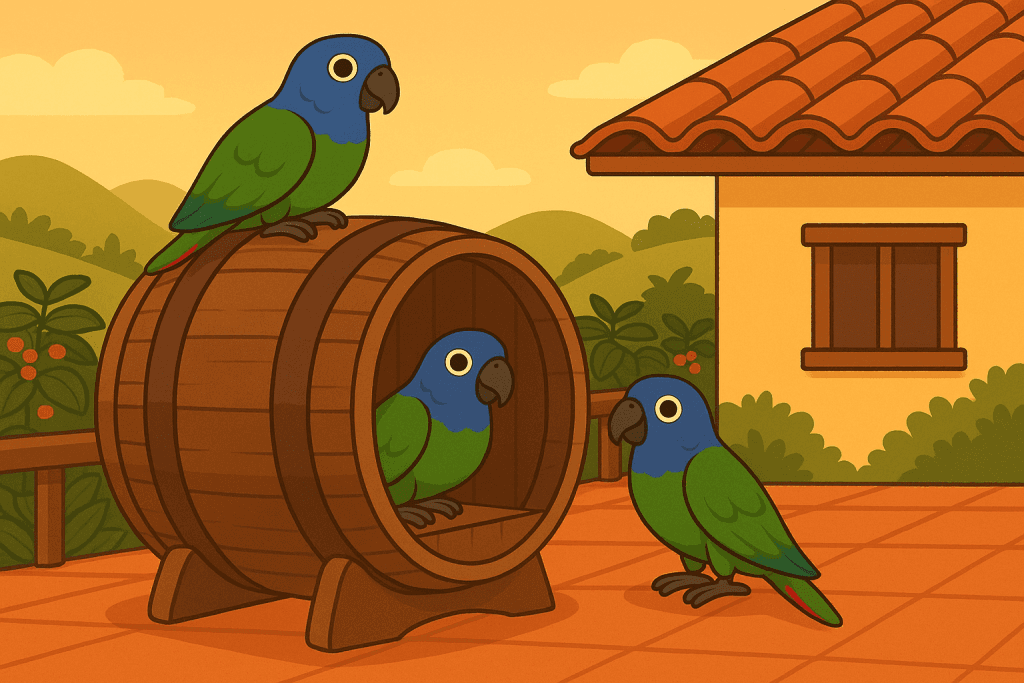
I built them a home on my terrace: an old wine barrel turned into an open-air shelter. Over time, whole flocks came to share food, as if an invisible message passed between them. It was a wonderful sight — one that, sadly, faded with urban sprawl, tree felling, and green spaces turning grey. That loss deepened my longing to live in the countryside… surrounded by the freedom of birds and dedicated to their conservation.
Though my heart ached when Pachita first left, her return with others of her species revealed a fundamental truth: real freedom for a wild animal lies in its natural habitat, alongside its own kind. Watching her interact with her mate, preening each other, hearing their songs in chorus… it was an invaluable lesson.
Pachita, my Pionus menstruus, left me with lessons I will never forget. She showed me the authenticity of friendship, the unconditional loyalty of a living being. She taught me to embrace my individuality, to stop feeling different… even to use that difference to my advantage — like when she would nip at anyone who got too close, earning me a peculiar reputation among my friends.
Imagining Pachita free, crossing the emerald skies of her home, fills me with a pure and indescribable happiness. Freedom is the essence of life. What meaning does existence have without the ability to be and move according to our own desires? No innocent being should be stripped of it.
This deep connection with Pachita — this awakening of my vocation through her brief but lasting presence — didn't just shape my solitary childhood: it laid the foundation for my path as a veterinarian. My daily work is driven by the same passion I felt when I held that small parrot in my hands; a fierce dedication to the health and wellbeing of wildlife.
The dream of visiting her world, of seeing up close the reserves that protect these remarkable creatures, is not just a personal longing: it is the conviction that I can learn from those sanctuaries and contribute to their conservation. I want to be an active part of protecting the winged beauty that once came to my window as an emerald whisper… a whisper that guided me toward a life dedicated to preserving the freedom I hold dear for every living being.
Analysis and reflections from Fundación Loros
Pachita's story shows that releasing a bird is not simply letting it go and hoping for the best. The young man applied, without knowing it, the principles of a soft release: he kept the parrot in a familiar environment, installed a barrel-nest on the terrace, and provided food and shelter while she explored her surroundings. That transitional station let her regain strength, bond with a flock of blue-headed pionus, and ultimately choose freedom without severing her tie to the territory.
The barrel turned nesting box served two key functions: it offered protection from predators and, at the same time, built a loyalty to the site. When Pachita returned with a male — and later with more of her kind — it was clear the place had gained ecological value for the species. The young man made no attempt to hold her back; he respected her comings and goings, understood that the real measure of success was watching her leave and, every now and then, come back on her own terms.
That simple process, repeatable in backyards and farms, holds a powerful lesson: conservation begins at home when we turn human spaces into stepping stones toward natural habitat. By offering temporary shelter, appropriate food, and freedom of choice, we reduce stress, support social learning, and increase the odds of survival.