Open protocols
Free-flight training vs. strict human isolation
By Alejandro Rigatuso · Founder and director, Fundación Loros
Abstract. Two approaches stand in tension in the rehabilitation of psittacines: strict human isolation, which aims to prevent habituation to people, and free-flight training in conservation programs, where a human acts as a temporary guide. Drawing on peer-reviewed literature and field results from Fundación Loros, this article argues that isolation alone avoids a risk but does not build the competencies that determine survival after release — flight, orientation, landscape use, homing, and social cohesion. Free-flight training develops these competencies and progressively transfers behavioral control from human support to the environment, the flock, and the site's resources. The goal is not for the bird to depend on people, but to stop needing them.
1. Two ways of understanding rehabilitation
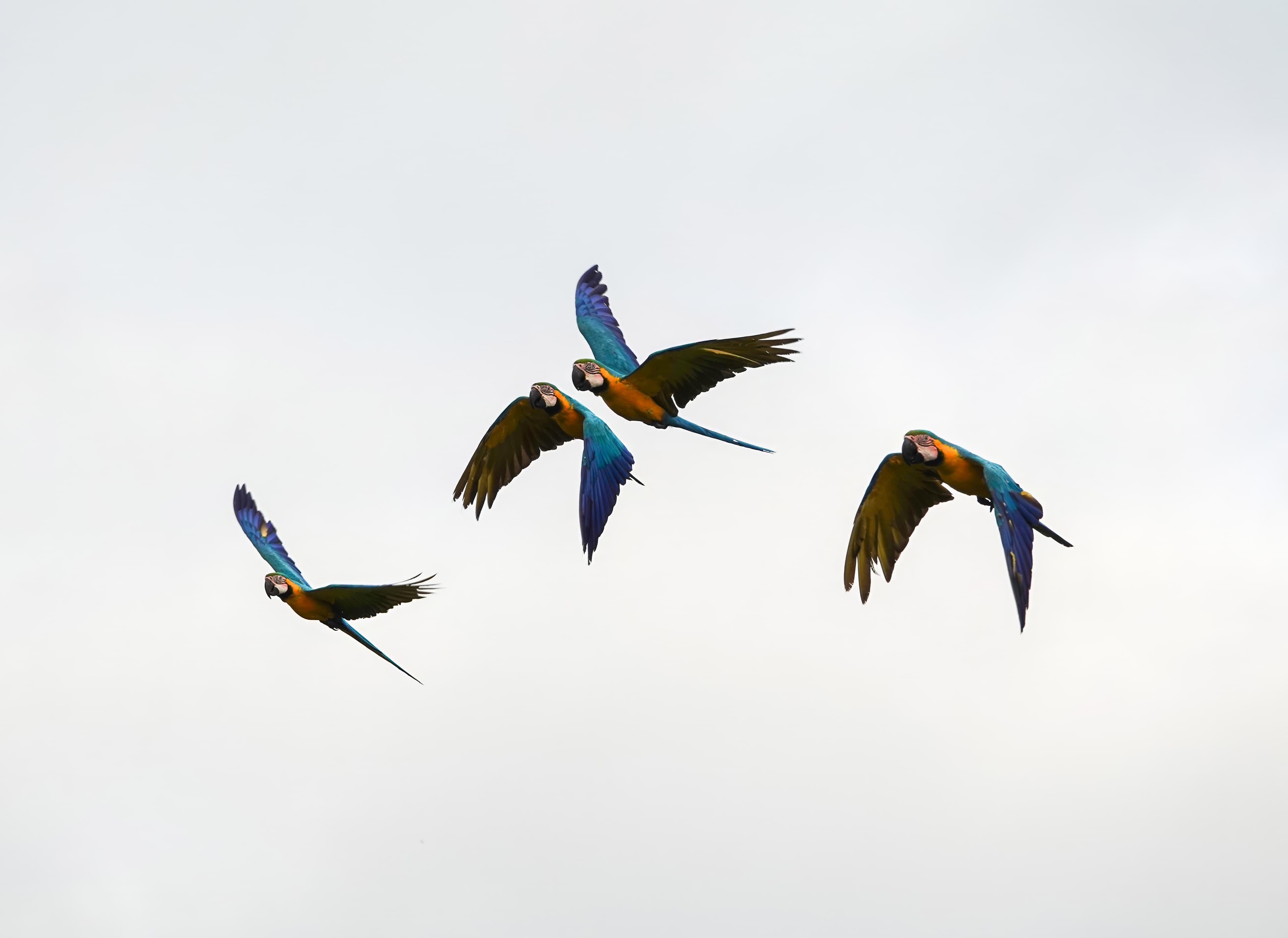
Free-flight training in conservation programs is a progressive learning method in which a human guides the rehabilitated bird to develop, step by step, the skills it will need in the wild: taking off and landing with control, building endurance, orienting itself, returning to a safe point, recognizing spatial references, and using the landscape with increasing autonomy. It is not about "releasing it to fly," but about accompanying a transition from controlled support toward functional independence — typically combining progressive flight, feeding stations, monitoring, and social structure.1, 5
That feature — the human acting as a temporary guide — has been criticized by those who argue that in rehabilitation, animals should be kept as far as possible from people. From that perspective, visible human contact, reinforced return, or guided training could generate dangerous habituation and interfere with life in the wild. To evaluate both positions, however, a broader question must be asked: which method produces birds that are less dependent on humans and, at the same time, better equipped to survive once released.1, 4, 5
2. What these approaches teach — and what risks they leave open
The strict human-isolation approach starts from a valid intuition: a parrot too habituated to people may approach dangerous humans, get captured, beg for inappropriate food, or display behaviors incompatible with life in the wild. For this reason, some programs cover cages, minimize visible human presence, deliver food through slots, and limit contact to strictly veterinary or logistical needs. Their main goal is to reduce the likelihood that the bird will seek out people after release.4, 5
The problem is that this approach, on its own, does not build the capacities that matter most during the critical post-release phase. In psittacine reintroductions, early survival depends heavily on physical condition, flight quality, spatial orientation, access to resources, social cohesion, site quality, and predation pressure. White et al. documented in Puerto Rico a mortality rate strongly associated with raptor predation, and Collazo et al. showed that protocol adjustments and better physical preparation could translate into marked improvements in survival. None of those bottlenecks are resolved simply by reducing the visibility or presence of humans.2, 3
This is where free-flight training shows its main strength: it does not only try to avoid a risk — it builds several competencies at once. Through gradual exposure, reinforced return, flight practice, and temporary support, the bird develops navigation, maneuverability, spatial memory, use of landmarks, site fidelity, and the ability to return to safe points or known resources. In other words, it learns the environment while learning to fly within it.1, 4
That matters because a successful release demands more than "not seeking humans." It requires the bird to know where to find water, where to find food, how to move through the landscape, where to take shelter, and how to return if something goes wrong. Free-flight training supports precisely that process of calibration to the environment, while strict human isolation may produce birds that avoid people but do not know the landscape well enough.1, 5
In this sense, the human role in free-flight training is better understood as a temporary scaffold than as a permanent substitute for nature. During a critical phase, the human helps structure flight paths, reinforce return points, maintain water or supplementation stations, and reduce the likelihood of serious mistakes while the bird is still learning. As the individual's competence grows, that support must decrease and give way to the environment, the flock, model birds, and the site's natural resources.1, 4, 5
In serious conservation programs, the goal is not for the bird to depend on people, but to stop needing them.
When the process works, the animal no longer stays near humans because it has been conditioned to "like" them, but because at first it needed them as a learning bridge; then, once the environment becomes legible and functional, it shifts its references toward existing flocks, roosts, useful trees, reserves, and routes that belong to the landscape.1, 4, 5
The critique of extreme isolation can also be framed in terms of animal behavior. The classic literature on misbehavior of organisms showed that training regimes that conflict with strong biological tendencies tend to be less stable or less transferable. In psittacines, it is more consistent with their biology to reinforce flight, orientation, social following, and return than to build the entire post-release strategy around a single negative and general behavior: avoiding humans in any context.1, 6
Fear does not always produce better decisions, either. One weakness of strict human isolation is that it can promote disorganized flight at the moment of release. If the bird leaves primarily by escaping the release point, it may move away from the best-managed zone: the site with known water, supplementation, monitoring, practiced routes, and protective support. From there, the risk of unproductive flights, disorientation, starvation, and entry into areas with genuinely dangerous humans increases.1, 2, 3, 5, 6
Paradoxically, a protocol designed to reduce human contact can end up pushing the bird to seek resources in worse human contexts. Hunger, thirst, and fatigue may lead it to beg for water or food on farms, roads, towns, or forest edges where exposure to capture, aggression, or accidents is greater. In other words, simply avoiding the caregiver does not guarantee avoiding dangerous humans; sometimes it only shifts the problem to a less controlled context.2, 3, 5
The evidence from Brightsmith et al. adds another important element: survival improves with larger groups and with the presence of established birds at the site. This reinforces the idea that sociality, shared learning, and integration into existing structures are central components of success. Free-flight training and other active preparation models fit that logic better because they build return behavior, cohesion, and social use of space.1, 4, 5
This does not mean that minimizing human contact is useless. It can be useful with highly imprinted individuals, in certain clinical phases, or when there is a real risk of inappropriate social reinforcement with people. As a partial tool, it makes sense. As a total philosophy, however, it tends to fall short — because it confuses absence of contact with ecological preparation.1, 4, 5
3. A case at Fundación Loros
The video above documents this approach at our own site: the training of a group of yellow-fronted parrots (Amazona ochrocephala) by Chris Biro at Fundación Loros. This release is documented in the peer-reviewed study Brightsmith, Rigatuso, Biro & Geiszler (2026), published in Bird Conservation International. Measured results after release:
- 100% of the birds used the project's feeding stations.
- 100% showed good flock cohesion.
- 94% showed good site fidelity.
- Return to feeding stations: 94% at one month, 89% at 3 months, and 72% at one year post-release.
Those numbers are exactly what the model predicts: birds that don't depend emotionally on people, but do know the site, return to their resources and hold together as a flock.
4. Toward autonomy-driven rehabilitation
If the goal is the successful release of rehabilitated parrots, the comparison should not be framed as "human contact yes" versus "human contact no." The right question is what kind of human support, for how long, and under what conditions, helps the bird become less dependent on people and more capable in the wild.1, 5
From that perspective, free-flight training in conservation programs offers a clear advantage: it uses the human as a temporary guide to develop spatial, ecological, and social skills that later sustain the bird's autonomy. Strict human isolation may reduce some habituation risks, but on its own it does not teach better flying, does not teach orientation, does not teach the bird to read the landscape, and does not guarantee that the bird makes good decisions during the most vulnerable phase of release.1, 2, 3, 5
In short, for reintegration programs, the model most likely to succeed is not the one that simply keeps the bird away from people — it is the one that progressively transfers control of the bird's behavior from initial human support to the environment, the flock, and the real resources of the release site.1, 4, 5
Key concepts
To understand this article
Free-flight training
A progressive learning method in which a human guides the bird to develop, step by step, the flight, orientation, and return skills it will need in the wild. It is not "releasing it to fly": it is accompanying the transition from controlled support to functional independence.
Stationing
Training the bird to return to a known Station or safe point (perch, feeder) on a signal. It provides a spatial anchor that reduces unproductive flights and makes monitoring easier during the critical phase.
"The Misbehavior of Organisms"
Classic work by Breland & Breland (1961): when conditioning conflicts with strong instinctive tendencies, trained behavior becomes unstable (instinctive drift). Implication: basing the entire post-release strategy on a single negative, general behavior — "avoid humans" — is fragile; reinforcing flight, orientation, and return is more robust.
Soft release
Gradual release with temporary on-site support — acclimatization, supplemental feeding, monitoring, and practiced routes — rather than an abrupt release. It increases survival odds while the bird calibrates its environment.
Site fidelity
The bird's tendency to stay in and return to the managed release area (familiar resources, flock, protection). It is an indicator that the process is working and the foundation of post-release protection.
Frequently asked questions
Does human contact "tame" the parrot and put it at risk?+
It is a real risk in highly imprinted birds, which is why it is managed through dosage and timing. But the contact involved in free-flight training is a temporary scaffold that decreases as the bird gains competence: the goal is not for the bird to bond with people, but to stop needing them — shifting its references toward the flock and the landscape.
How long does rehabilitation take?+
There is no fixed-duration protocol: it depends on the individual, its history, and its condition. It is a living process that respects the bird's own timeline; it can take months or years.
What exactly is soft release?+
A gradual release with on-site support (acclimatization, supplemental feeding, monitoring, and practice routes) instead of an abrupt release, so the bird can read its environment with less risk.
Does this apply to macaws too?+
Yes. The cited evidence includes reintroduction of macaws (Ara macao); the principles — physical conditioning, flight, social cohesion, and temporary on-site support — apply to psittacines in general.
References
- Woodman, C., Biro, P. A. & Brightsmith, D. J. (2021). Parrot Free-Flight as a Conservation Tool. Diversity 13(6):254. doi:10.3390/d13060254. mdpi.com
- White, T. H., Collazo, J. A. & Vilella, F. J. (2005). Survival of Captive-Reared Puerto Rican Parrots Released in the Caribbean National Forest. The Condor 107(2):424–432. doi:10.1093/condor/107.2.424. bioone.org
- Collazo, J. A., White, T. H., Vilella, F. J. & Guerrero, S. A. (2003). Survival of Captive-Reared Hispaniolan Parrots Released in Parque Nacional del Este, Dominican Republic. The Condor 105(2):198–207. doi:10.1093/condor/105.2.198. pubs.usgs.gov
- Brightsmith, D., Hilburn, J., del Campo, A., Boyd, J., Frisius, M., Frisius, R., Janik, D. & Guillén, F. (2005). The use of hand-raised psittacines for reintroduction: a case study of scarlet macaws (Ara macao) in Peru and Costa Rica. Biological Conservation 121(3):465–472. doi:10.1016/j.biocon.2004.05.016. vetmed.tamu.edu
- White, T. H., Collar, N. J., Moorhouse, R. J., Sanz, V., Stolen, E. D. & Brightsmith, D. J. (2012). Psittacine reintroductions: Common denominators of success. Biological Conservation 148(1):106–115. doi:10.1016/j.biocon.2012.01.044. sciencedirect.com
- Breland, K. & Breland, M. (1961). The Misbehavior of Organisms. American Psychologist 16(11):681–684. doi:10.1037/h0040090. psych.hanover.edu
- Brightsmith, D. J., Rigatuso, A., Biro, C. & Geiszler, D. (2026). Successful release of confiscated Amazona parrots using free-flight training. Bird Conservation International 36:e24, 1–10. doi:10.1017/S0959270926100537. cambridge.org
About the author
Alejandro Rigatuso is the founder and director of Fundación Loros. He leads the rehabilitation and reintegration model for psittacines in the tropical dry forest of Villanueva, Bolívar, Colombia.
A popular science article based on peer-reviewed scientific literature. Published by Fundación Loros as part of the opening of its working protocols.
This is how we apply it at the sanctuary
Discover the full rehabilitation and reintegration process for psittacines at Fundación Loros.