Open protocols
Human-Guided Behavioral Development: the principle of free-flight in conservation
By Alejandro Rigatuso · Founder and director, Fundación Loros
Abstract. Free-flight training is a technique with demonstrated potential for the reintroduction of psittacines. The theoretical principle behind it is called Human-Guided Behavioral Development: rather than training specific behaviors one by one through operant conditioning during prolonged captivity, the method allows the bird to develop its survival repertoire — flock flight, evasion, navigation, foraging — through guided interaction with real environments of increasing complexity.1, 2 The method applies in practice to birds of any age, but the three formal studies available worked with young birds, where the critical learning window after fledging (post-fledgling) allows for faster learning. This article explains the concept, describes the six environmental levels (0 to 5) that structure its application, and presents the results of the trial conducted at Fundación Loros with 18 Amazona ochrocephala seized from illegal trade.3
1. The problem
Psittacines are one of the most threatened orders of birds on the planet.4 Release projects face a persistent problem: first-year survival rates after release are typically below 50%,5 driven by predation, low site fidelity, poor navigation, and low flock cohesion. The traditional approach addresses each deficit with a specific intervention and keeps the bird in captivity for a year or more before release. The conceptual cost is rarely discussed: birds spend the critical learning window after fledging — between three and seven months of age in macaws — learning to survive in a cage. When released, they are expected to perform a behavioral repertoire they never had the chance to build.
2. The concept
Human-Guided Behavioral Development inverts the logic. The trainer does not teach specific behaviors; they guide the bird through a carefully selected sequence of environments where relevant behaviors emerge spontaneously from interaction with the surroundings.1 The human temporarily replaces the wild parental role: defining the environmental trajectory (which site, at what moment, with what risks) and allowing reversibility through a minimum of operant conditioning limited to three instrumental behaviors — returning to the trainer (recall), leaving a dangerous location (get-off), and heightened vigilance in response to the human alarm call. Everything else — cohesive flock flight, evasion, navigation, foraging, collective predator mobbing — is not explicitly trained. It emerges.
The method can in practice be applied to birds of any age — pet bird trainers regularly work with adults — but formal conservation studies have used young birds because the critical learning window after fledging allows substantially faster learning. Application to confiscated adult birds, the majority of the population arriving at rehabilitation centers in Colombia, is an open question that requires specific research.
3. The six environmental levels
The core of the method is a progression through six environments of increasing complexity. Each level defines environmental characteristics and behavioral mastery criteria. The bird advances only when it meets the criteria of the current level.1
Level 0 — Indoors
Controlled enclosed space, no wildlife. The bird accepts food from the trainer, returns on the trainer's call, leaves perches on the get-off cue, flies throughout the space, and initiates basic aerial maneuvers with cohort companions. The human-bird bond and the foundations of the three instrumental behaviors are established. Typical duration: through weaning and consolidation of flight, approximately 70 days in parakeets and 100 days in macaws.
Level 1 — Flat open spaces
Flat fields with minimal vegetation, light wind, distant wildlife. The bird flies at varying altitudes, builds endurance with continuous flight over several minutes, begins cohesive flock flight outdoors, and tends to stay near the regrouping vehicle. Characteristic risk: panic flights. This is why Level 1 sites are chosen without distant perches: if the bird flees, it tires and returns. Typical duration: ~3 weeks.
Level 2 — Scattered vegetation with non-dangerous wildlife
Shrubs, isolated trees, non-dangerous wild species that may mob (mockingbirds, gulls, other corvids). The bird responds to the call from trees, selects perches with a clear takeoff path, executes coordinated group escape initiated by any flock member, and re-establishes contact after losing sight of the trainer. Cohesion under social stress is built, along with the first experiences of collective mobbing. Here the bird learns to distinguish nuisance wildlife from a real predator.
Level 3 — Complex topography with investigative predators
Elevation changes, open forest, investigative pursuit by raptors without sustained attacks. The bird learns the landscape through circular exploratory flights, consolidates routes between landmarks, flies in bursts, and develops complex aerial escape maneuvers. Collective mobbing emerges as a group behavior and spatial memory of the territory develops. The bird responds to the call after 2–3 minutes of lost line of sight.
Level 4 — Water bodies and committed predators
Significant waterways, heavy rainfall, the possibility of pursuit by a committed aerial predator. The bird manages cliffs, executes escape dives, and consolidates intelligent disobedience: rejecting trainer cues when a risk is present, until the risk has passed. This marks a qualitative shift — the bird stops being a trained subject and becomes an agent that evaluates.
Level 5 — Full functional independence
Extreme landscape, low visibility, immediate threat from committed predators, recovery not possible. The bird functions independently between sporadic trainer calls. No new skills are added; existing ones are consolidated under conditions where the trainer can no longer intervene. A bird at Level 5 is functionally equivalent to a wild adult.
4. The experience at Fundación Loros
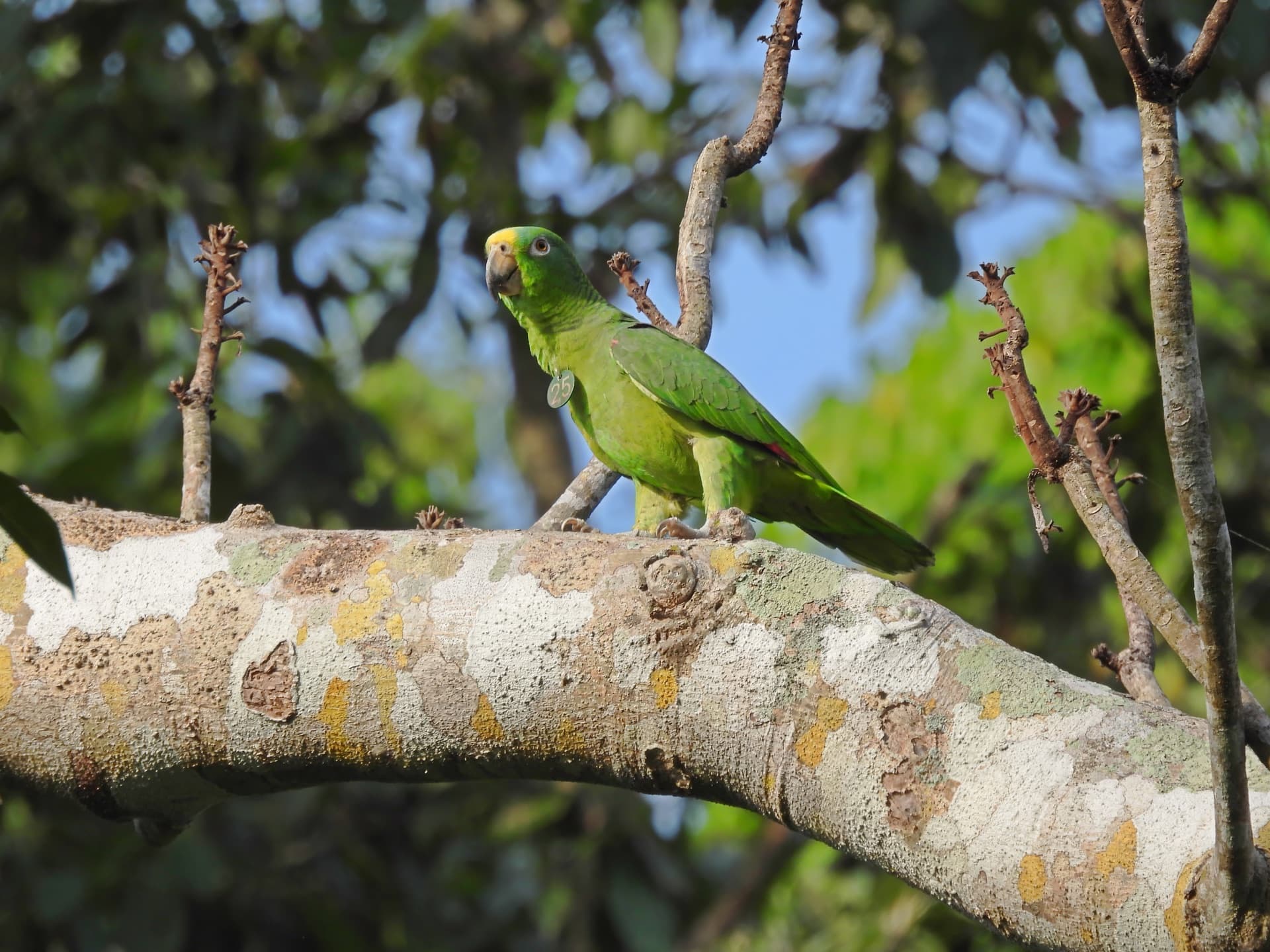
In 2023, Fundación Loros received 27 Amazona ochrocephala seized from illegal trade in Cundinamarca, transferred approximately 600 km from their capture site. The birds arrived between fledging (8–9 weeks) and weaning (16–20 weeks), with prior histories of human handling of undetermined duration in quarantine centers. Of the 27, 18 were deemed suitable for the first trial. The work was carried out in collaboration with Chris Biro (Liberty Wings) and Donald Brightsmith (Texas A&M), and its results were published in Bird Conservation International (Brightsmith, Rigatuso, Biro & Geiszler, 2026).3
The trial extended the method in three directions that make it particularly relevant to the Latin American context:
First, confiscated birds rather than hand-raised birds from a commercial breeder. Previous studies worked with chicks raised from an early age in environments explicitly designed for the method. This is the first documented case of the method applied to a population arriving with a prior history of inadequate captivity — the scenario that is the norm in real rehabilitation programs across Latin America.
Second, a training cycle radically compressed to 18 days. The birds arrived at or near fledgling age, within the critical window the method is designed to use. The progression through environmental levels was accelerated but complete: five days to master point-to-point flight at 15 m inside the aviary, outdoor flights beginning on day 14, final release on day 18. The compressed cycle shows that training duration is not a fixed parameter of the method — it adjusts to the age at which the bird enters.
Third, no nucleus flock. Unlike the previous Brazilian trial, no previously trained adult birds were used as social models. The 18 released birds functioned as their own learning cohort, demonstrating that the method can be initialized at sites without established mentor birds.
Results at the close of the study:
- 100% of birds used the feeding stations at the time of release.
- 100% flock cohesion observed during the monitoring period.
- 94% site fidelity.
- Survival: 94% at one month, 89% at three months, 72% at one year.
- Zero direct evidence of predation, with documented presence at the site of Micrastur semitorquatus, Buteogallus anthracinus, Leopardus pardalis, and Eira barbara, among other predators capable of taking an adult bird.
The trial also documents a component that earlier studies had not formalized: community engagement as an integral part of the design. The Foundation built an alliance with approximately 70 local farmers through land-use agreements for cassava cultivation on plots within the territory, a geo-targeted digital campaign on Facebook and Instagram with a budget of USD $755 that reached close to 1.1 million impressions, public events in Villanueva, television segments, and ongoing communication via WhatsApp with residents within a 10 km radius. Three specific community reports made it possible to recover two captured birds and prevent inappropriate feeding behaviors before they became established. In anthropogenically modified landscapes — which dominate real conservation settings across Latin America — community engagement is not optional; it is structural.
5. Context: the other two studies
The Loros trial sits within a line of three converging studies. Woodman, Biro, and Brightsmith (2021) documented the training of 37 birds across seven species over 17 years, accumulating 501 flight-months in environments with high predation pressure, with no single loss to predation.1 Brightsmith, Biro, Mendes, and Woodman (2024) conducted the first formal reintroduction trial using the method, releasing six Ara ararauna in Brazil with 100% first-year survival.2 The Loros trial (2023) is the third, and the first to apply the method to confiscated birds in an inhabited rural Latin American landscape.3 All three converge on rates of cohesion, site fidelity, and survival that substantially exceed those reported for traditional methods.5
6. Implications and limitations
The operational implications are clear. Training duration adjusts to the bird's age at entry within the critical window. The method works with confiscated birds, not only hand-raised ones. Initialization without a nucleus flock is viable. And in human-modified landscapes, community engagement is structural to the design, not incidental.
The limitations are equally clear. The available studies cover 61 birds in total: a notable empirical base, but not a conclusive one. No trial has included a direct control group. All three published studies worked with young birds; applying the method to confiscated adults — the majority of birds arriving at rehabilitation centers in Latin America — is an open question. Fundación Loros is currently working in this direction, though without published results yet. Approximately 17% of released birds may show problems with excessive human-directed tameness, the most consistent failure mode of the method across the available studies.2, 3
Conclusion
Human-Guided Behavioral Development is not one more training technique; it is a shift in the paradigm for how psittacines are prepared for release. Rather than compensating for deficits with specific pre-release training, the method works to prevent those deficits from forming during the critical developmental window. The Fundación Loros trial contributes what the Latin American context needed most: proof that the method moves out of the niche of private aviculture and into the operational space where psittacine conservation in the region actually happens — with birds from illegal trade, on constrained budgets, in inhabited rural landscapes, and built around local community networks.
Acknowledgements
Most of the concepts presented in this article — Human-Guided Behavioral Development, progression through environmental levels, and the role of the trainer as a temporary guide — were introduced to the author by Chris Biro (Liberty Wings), a pioneer of free-flight applied to conservation. For further reading, we recommend the two papers that ground this approach: Parrot Free-Flight as a Conservation Tool (Woodman, Biro & Brightsmith, 2021) and Free Flight Training as a Tool for Psittacine Reintroductions (Brightsmith, Biro, Mendes & Woodman, 2024).
References
- Woodman, C., Biro, C. & Brightsmith, D. J. (2021). Parrot Free-Flight as a Conservation Tool. Diversity 13(6):254. doi:10.3390/d13060254. mdpi.com
- Brightsmith, D. J., Biro, C., Mendes, H. F. & Woodman, C. (2024). Free Flight Training as a Tool for Psittacine Reintroductions. Birds 5(3):522–542. doi:10.3390/birds5030035. mdpi.com
- Brightsmith, D. J., Rigatuso, A., Biro, C. & Geiszler, D. (2026). Successful release of confiscated Amazona parrots using free-flight training. Bird Conservation International 36:e24, 1–10. doi:10.1017/S0959270926100537. cambridge.org
- Olah, G., Butchart, S. H. M., Symes, A., Guzmán, I. M., Cunningham, R., Brightsmith, D. J. & Heinsohn, R. (2016). Ecological and socio-economic factors affecting extinction risk in parrots. Biodiversity and Conservation 25:205–223. doi:10.1007/s10531-016-1036-7. link.springer.com
- White, T. H., Collar, N. J., Moorhouse, R. J., Sanz, V., Stolen, E. D. & Brightsmith, D. J. (2012). Psittacine reintroductions: Common denominators of success. Biological Conservation 148(1):106–115. doi:10.1016/j.biocon.2012.01.044. sciencedirect.com
About the author
Alejandro Rigatuso is the founder and director of Fundación Loros. He leads the rehabilitation and reintegration model for psittacines into the tropical dry forest in Villanueva, Bolívar, Colombia.
Popular science article based on peer-reviewed scientific literature and the author's own field experience. Published by Fundación Loros as part of the opening of its working protocols.
This is how we apply it at the sanctuary
Discover the full rehabilitation and reintegration process for psittacines at Fundación Loros.