Macaw Chorus
By Carlos Andrés Paniagua Delgado · Colombia, Medellín · Scarlet macaw (Ara macao)
This story is chapter II of The Spirit of the Parrots.
"Rina escaped, Rina escaped!" the farmhands were shouting. I watched my uncles run out, pulling off their shirts, toward the workers who were running and yelling that the macaw had gotten loose. My grandfather had bought Rina a few years earlier. When he brought her to live on the farm where he, my grandmother, and my uncles lived, she caused a sensation. Not only was she a splendid animal — with the colors of the flag, more vivid and bright than you can imagine — but Rina talked. It's common for parrots to talk, but it's not so common for macaws. They built the talkative bird a large, beautiful cage, wire mesh with a zinc roof, very spacious, set outside in a corner of the front garden, close to the main house.
The first few days, Rina called out for Julia and Pachito — two names no one in our family recognized. The adults concluded they must have been her previous owners. Rina called for them and asked for bread, laughed and chattered in her bright new cage, and seemed to enjoy the rain especially, because she'd make a tremendous racket, singing and laughing. Little by little she stopped calling for Julia and Pachito, and learned the names of my grandparents — thanks to my grandmother's dedication. She spoiled her with crackers and fruit every day and spent hours talking to the parrot, until she came to recognize every member of our large family.
Every time we came to visit the farm during the holidays, Rina recognized us and called each of us by name, and the children in the family had a great time chatting with her. She was a true marvel of intelligence and beauty. When we went back home after the holidays, our house filled with vases of colorful, bright feathers that my grandmother collected whenever Rina shed them, to decorate the farm and give to her grandchildren. There were always macaw feathers in my home during those years, and it was just a normal thing. Rina was as beloved as Pecas and Carola, the farm's pet dogs — except that Pecas and Carola never called anyone by name. Rina did.
Many years passed and the macaw was like part of the family, always in her wire cage. "They live up to 80 years," I heard someone say once; I never knew if it was really true. But Pecas and Carola lived and died, and then came Pitufina, a small, skinny mixed-breed dog; she lived and died too, and Rina was still there, in her cage.
One ordinary day during a vacation, I was playing with my brothers on a hillside near the entrance to the farm when we heard the commotion: Rina had escaped. From the height of the hill we could just make out my uncles running, waving their shirts at the sky, the farmhands behind them — a hilarious scene — while above them all we saw the magnificent animal flying, her long tail trailing and wings outstretched. It was actually a magnificent sight, because we were above her in elevation, and I remember thinking she was a different macaw, not Rina, because ever since I was very small I had only seen her in her cage, perched, sometimes with her wings spread, but never in flight. It would have been something beautiful had we not loved her as a pet, and the thought that she had escaped filled me with dread and confusion in that moment. She kept flying until she disappeared into the brush and forest beyond the farm's borders.
For hours, the search for Rina was fruitless, and back at the house my grandmother lit candles to her saints to bring her back. After so many years in captivity, the fear was that the poor bird wouldn't be able to survive in the wild. Just before nightfall, while my grandmother and the grandchildren prayed the rosary — partly because it was tradition to do so every day at six, and partly to ask that they find Rina — my uncles arrived triumphant. I finally understood why they had taken off their shirts, because uncle Rafa was carrying the macaw carefully wrapped in his. Rina didn't seem hurt or frightened, but she had powerful claws and a very strong beak; it was better to keep her wrapped, for her sake as much as for my uncle's, so she wouldn't bite, because my grandfather used to say that if you weren't careful she could take off a finger with a single peck. The macaw was quickly back in her cage, calling anxiously for mamá Ketty, reciting verses from the rosary — which she knew by heart too.
When my grandfather had an accident in the farm's coffee grove and had to have surgery on his arm and a metal plate put in, the family decided the best thing for his recovery was to sell the farm and move back to the city. That was how Rina came to live in Medellín. The family home had a large courtyard, and they built her a cage just as big and spacious as the one at the farm. But unlike that one, which had views of the brush and the countryside on all four sides, this cage was built wall to wall, so it only faced the front of the courtyard and the interior window of my grandparents' bedroom. No more trees, no garden flowers, no wild birds, no clouds, no countryside for Rina.
More years passed, and Rina lived in the courtyard, as talkative and mischievous as ever — she loved to laugh and sing — still recognizing everyone in the house and calling them by name. When we got home from school, Rina called each of us by name and we went to say hello. We brought her mangoes and papaya, and laughed when she scolded my uncles, imitating my grandmother's voice almost perfectly — a voice from which she had learned not only to pray, but to nag.
So it was very strange when, one ordinary day, my grandfather asked me — because I was the oldest grandchild, my uncles having long since made their own lives and moved out — to help him with something. He handed me an old blanket and told me to help him take Rina out. When I looked at him in confusion, he said he was going to give her to the zoo. My grandmother, my mother, and my aunts argued and shouted — how could he, had he lost his mind, what had gotten into the grandfather, how could he even think of giving away poor Rina after all these years — but nothing could change my grandfather's mind. I obeyed more out of fear of being punished if I didn't than out of understanding his reasons. The complaints and shouting turned to tears and pleas, but as we took the macaw out of her cage, my grandfather only kept repeating that the poor animal was too cramped in that cage, that it wasn't fair for her to live there, that she would be better off in a zoo. None of that relieved the feeling of confusion and helplessness. How could my grandfather do this to a pet we had loved for so many years?
Just then a wind crossed the courtyard carrying the smell of the countryside, a smell that did not belong in that city, and for one second I felt the wire so close and the sky so far away, an urge to spread wings that were not mine. It lasted only an instant, and I never told anyone.
With great reluctance I helped wrap poor Rina in the blanket. She was docile, but every now and then she pushed back and snapped, yet surprisingly, on the drive to the zoo, she was very calm and even let me stroke the small feathers on her head. I was trying to hold back tears — because according to my grandfather, men don't cry — but it truly felt like a final goodbye. I had a deep affection for the macaw and could no longer remember what it was like to live in a house without her: without her noise in the morning, which woke everyone more efficiently than an alarm clock; without her litanies and prayers at six in the afternoon; without the joy she showed when it rained. But I did remember the frightened screams she let out when thunder crashed: "Santa Bárbara bendita, protégenos de todo mal!" she always said whenever lightning struck.
When we arrived at the zoo, my grandfather went ahead and I carried the precious cargo carefully, in the middle of great distress. My grandfather spoke to someone at the entrance and we were shown into an office where a man received us kindly and, presented with my grandfather's offer, asked the reason while I handed over the wrapped macaw. The man examined her closely; his skill handling this kind of animal was clear. He held her firmly, without fear but without roughness; he spread her wings gently and looked her over carefully, while my grandfather told him she had been living in a cramped cage and barely got any sun. I almost burst out laughing — but held it in — when the vet told my grandfather that was precisely why her feathers were so beautiful and bright, because sun fades feathers. I remember thinking: "That's it, this man isn't going to take her," and I felt some relief — which, however, didn't last long. Despite my grandfather's insistence, the vet said he would accept her, but that he couldn't put her with the other macaws right away — who, by the way, didn't live in cages at the zoo but quite happily in the trees around a small artificial lake — because she was a stranger, and introducing her suddenly might mean the other macaws wouldn't accept her and would attack her, or might even kill her. At thirteen, I asked the vet with concern whether she would truly be better off there than at home, with her family, and he said yes, that she would be with others of her species, but that she first had to go through a quarantine period, that he couldn't let her loose right away like the other macaws who were already used to living free. I kept asking questions, curious, always with the memory of the day Rina escaped on the farm in my mind — how did they keep the zoo's macaws from flying off if they weren't caged — and he explained that they knew their territory, that they even flew around the surrounding city and then returned to the zoo because that was their home; that Rina would be caged for a while, and that he would introduce her to the other macaws gradually until they got used to her and she could be released. I told the vet that Rina talked, that she recognized all of us in the house, that she prayed. The vet didn't seem surprised; he said they were very intelligent, that it wasn't very common for macaws to talk, but it wasn't impossible either. What saddened me most, though, was when he told me that once she was integrated into life at the zoo and in contact with other macaws, she would quickly forget how to speak. With a broken heart and a quiet resentment toward my grandfather — because I couldn't understand his sudden reasons for giving away a beloved pet — we went home. In the car I noticed my grandfather looked sad, which was extremely unusual for someone who didn't like to show his emotions, neither affection nor pain, in public. "It's best for her; she'll be fine here," was the only thing he said to me the whole way.
When I was 23, the Drawing I professor at the Faculty of Arts at the Universidad de Antioquia told us we were going on a field trip to the zoo to learn to draw animals in their environment. I hadn't been there since the day we brought Rina. At that moment I didn't even think of her: I was only thinking about the drawing exam and how on earth we would draw animals that don't stay still posing for the artist.
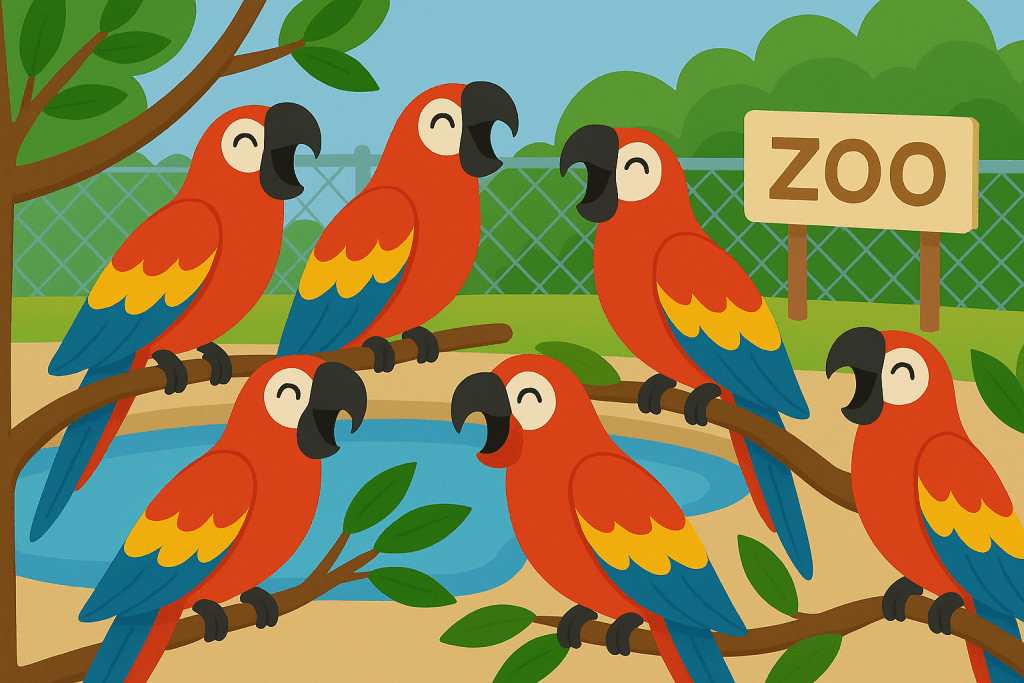
When we arrived at the zoo, the group of students spread out and I stayed with a couple of friends, looking for the stillest animals to try to draw them — despite our professor's insistence that we shouldn't look for stillness, but instead seek out active animals to capture their "gesture," as he called it. When we finished drawing (I drew a tigrillo that never held still, for the record), I walked around the zoo with my friends. When we reached the small lake surrounded by trees, I saw a flock of macaws — beautiful, free, settled into life in their oasis in the middle of the city. Suddenly, a voice identical to my grandmother's began calling out to me: "Llegó Andresito, llegó Andresito!" My eyes filled with tears at hearing my grandmother's voice in the call of a macaw. I tried to identify which one it was, wanting to recognize my dear Rina, but it was impossible, because quickly that voice crying "llegó Andresito" became a chorus of macaws all shouting my name. I knew Rina was there, even though I couldn't recognize her, even though she recognized me after all those years. She had not only not forgotten how to speak — she had taught the other macaws to speak.
When I got home, I told my mother and grandmother what had happened: that Rina had recognized me and called out to me, and that a chorus of macaws had shouted my name, and that half the zoo had witnessed that extraordinary macaw choir. With sadness, I let slip a reproach toward my grandfather for the decision, that day, to give Rina away. It was then that my grandmother told me he had given her away because he knew he was going to die soon and felt remorse for keeping the macaw in a cage; that it was one of the things he wanted to do before he died so he could go in peace.
When I was thirteen, I had two great losses: we gave Rina to the zoo, and that same year my grandfather died of pancreatic cancer.
Analysis and reflections from Fundación Loros
Rina's story shows that the best intentions can get tangled up in cages — but also that it's never too late to find your true community. For years, she lived with humans who loved her, learned her names, and celebrated her intelligence. Yet nothing could replace the nest of her own kind.
When she finally arrived at the zoo, her fate took on a hopeful shade: she was no longer sharing captivity with dogs and people, but with other macaws. That cage near the lake became a shared playground, where her calls were answered and her songs mixed into a living chorus. Had she been left alone, her intelligence and vitality would have faded into solitude; reunited with her peers, she recovered at least a glimpse of her natural life.
It's worth noting that many macaws in captivity "talk" because they get smiles and applause every time they imitate human words. That reinforcement leads them to repeat sounds to connect with us. But in full freedom, they gradually stop "talking" — they no longer need to, because they communicate through subtler calls, gestures, and synchronized flight.
Not all birds, however, can return to that ideal state of full freedom. Going back to the forest carries risks — predators, inability to find food, unfamiliarity with the territory — and they don't always have the structure or prior training to survive.
Rina never reclaimed the jungle, but she found genuine company: she learned to fly in a group, to share branches, and to build bonds with other macaws. Her journey reminds us that when we care for a wild bird, the most valuable thing is not avoiding human loneliness — it's guaranteeing the embrace of its own community. Because, in the end, a parrot beside its own kind sings louder than any gilded cage.