A beloved company
By Perlita · Colombia, Mosquera · Blue-crowned parrot (Amazona farinosa)
This looks like a story like many others, but it isn't: it's about the friendship between a beautiful, beloved parrot and Juanita. Juanita is a small, slight girl — so thin that the August winds moved her like a kite. One day, her mother told her that the son of her confirmation godmother would be coming to visit the family, and that he was bringing a wonderful surprise.
The long-awaited day finally arrived. Some people fluttered around the house with excitement, others ran back and forth waiting for the visit. Then came the knock of the door knocker. Everyone crept over quietly, and there he stood — with the impeccable bearing of a sailor — the person carrying the surprise: a small cardboard box full of unusual holes. They all looked at each other, intrigued, waiting to see what was inside that strange box.
The afternoon passed with laughter and stories about a beautiful town on the Amazon, Puerto Leguízamo. They talked about the color of the river, the green of the jungle, the deep blues of the sky, and the humid heat of the rain — but what captured everyone's attention most was the wildlife: parrots flying everywhere, monkeys, all kinds of birds. It sounded like a paradise everyone wanted to visit. Then, in the middle of the conversation, the visitor opened his box full of those strange holes. First a head appeared, then a black beak, and finally the whole body. "A parrot, a parrot!" everyone shouted. The bird spread its wings and immediately looked for somewhere to perch. There, among them all, stood Juanita, taking in this beautiful gift: she studied it closely and saw that it was a piece of the jungle — wings in many shades of green, a chest carrying the different tones of the sun, a head holding the blues of the sky. While Juanita stood absorbed, she felt that bird land on her fragile shoulder. Everyone shouted, but Juanita looked at it in silence. In that look, a beautiful and brief friendship began.
Everyone rushed to see this gorgeous bird perched on the shoulder of the thinnest, quietest girl in the house. They wanted to touch it; some offered a finger for it to land on, but only managed to frighten it. Then the mother lifted the bird from Juanita's shoulder and went out to the patio, where next to the washbasin stood a beautiful flowering curuba vine with its delicate pink and fuchsia blooms. It was the perfect spot for such an endearing gift to settle in peace, away from the children's games and chasing.
The ritual began right away: during the day, the beautiful bird went on the curuba vine; at night, in a cage, where it was tucked in with a baby blanket. Soon everyone noticed how gentle the parrot was — so different from doña Magdalena's lora, who lived a few houses away and did nothing but squawk profanities. Their new guest didn't speak yet, but he made himself understood. Many people noticed he still had no name and started thinking of what to call him. Juanita, always quiet and thoughtful, finally spoke: "He'll be called Ruperto." Everyone nodded and agreed.
The little parrot began to settle in and would keep Juanita company late into the night during her schoolwork, waiting for her to tuck him in and wish him good night. The companionship didn't stop at homework: Ruperto soon made his way to the dinner table and sat beside Juanita, who had serious trouble eating — she simply didn't like food. Ruperto started eating near her, and this had a positive effect on the girl, who began to eat more. Her father didn't like having him at the table, but when he saw his daughter improving after a long bout of hepatitis, he let it go. Everyone offered Ruperto bread with hot chocolate, fruit, and what he loved most: curuba.
In time, the parrot learned to talk. The name he repeated most was "Lalo," because that's what he heard most often — called out for the older brother, who would sneak across the rooftops to play football, eat gelatin or chocolate up on the roof, and every time he was caught, his parents shouted his name. In time, Ruperto started asking for chocolate with bread, and his bond with Juanita grew even stronger: he would see her cry and fly straight to her. They played, laughed, kept each other company, and kept the ritual: during the day, on the curuba vine, he would roam the house calmly, pick up pencils and colored markers, peck at them, and fly off with them — it was a whole spectacle watching him everywhere. At night they would bring him in from the patio, put him in the cage, and cover him with a baby blanket.
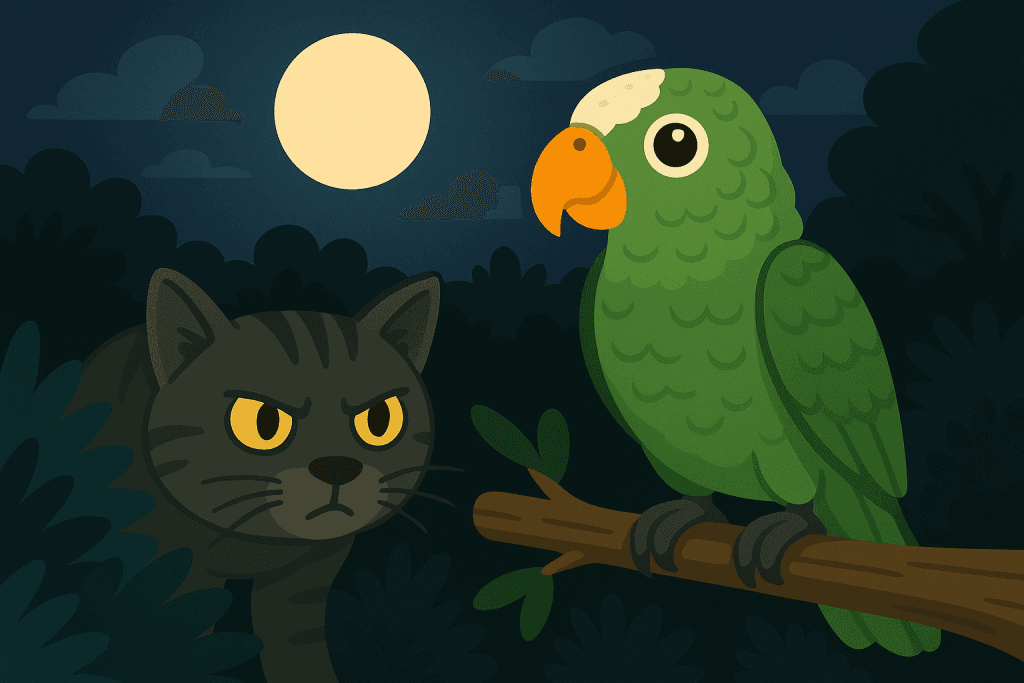
Time passed and the bond deepened, until one day Juanita's younger brother fell ill. Everyone worried about him and forgot about Ruperto. The next morning they found him on the curuba vine — cold, wings spread and drooping, very still and silent; his eyes were full of sorrow. Juanita picked him up and brought him to her mother, who wrapped him in his baby blanket, but Ruperto didn't respond. They soon understood that the fear which had always lurked at the edges had become real: spending the night on the curuba vine was dangerous. Like in the jungle, hunters prowled — the cats, who back then were kept only to catch mice and fed on milk, went out at night, and any defenseless creature was a feast.
The morning passed in deep sadness. Juanita had afternoon classes and left for school at 11:30 AM; the school route picked her up. She spent the whole day restless, thinking about her friend, counting the hours until she could go home. When she arrived, she ran straight to the patio where she had left him in her mother's arms. She found nothing — only the disturbed soil of the garden. She ran to her mother and asked about her friend, her piece of heart, Ruperto. Her mother looked at her with a deep, sad gaze and replied:
— My love, the parrot — when he felt you had taken the route to school, he stopped existing.
Juanita, broken with tears, found no comfort; the whole house wept. Her problems with food returned, and they have stayed with her all her life. She promised herself she would dedicate her life to helping animals, but life had other plans.
Juanita asked her mother never to have pet birds again. Even so, someone gave her a parakeet to cheer her up, and she decided not to grow as attached as she had with Ruperto. That new bird walked around the house — half the size of Ruperto — and one day it simply vanished. She asked the woman who helped in the house, and the woman answered with a mocking look that a cat had gotten in and eaten it. When Juanita asked why she hadn't done anything, the woman replied without a trace of remorse:
— I don't like parakeets.
Juanita ran to her mother, and together with her siblings, they asked her never again to keep such beautiful birds in the house — because they deserve to be free and live in peace in nature.
Years passed. She never stopped having animal companions, but she kept the memory of her great friend, the parrot Ruperto, in the deepest part of her heart. As an adult, she watched the film Paulie for the first time and immediately thought of Ruperto: the relationship between the girl and the bird who helped her speak, the pain of separation, and the adventures the bird lived in freedom. What she loved most was watching him fly freely to find his friend; what she loved least, not being able to speak. Every scene took her back to those moments with her beloved friend. The only difference is that Juanita never fully overcame her problems with food; for a long time those struggles marked her. But the one thing she carries in her heart is the memory of her friend. Now, when she goes to the countryside, she spends hours watching parakeets in the sun or the rain, observing how they relate to each other, and there she remembers those beautiful moments with Ruperto: she imagines him in each of them, enjoying his freedom, and she asks life that, when the time comes to leave this world, Ruperto will be the first to receive her — with his flutter and his white light.
Analysis and reflections from Fundación Loros
The friendship between Juanita and Ruperto is a lesson in tenderness and respect: that small piece of forest perched on her shoulder grew from shared silences and gestures of genuine care. Juanita learned to feed him without imposing on his space, to recognize his character, and to offer companionship without possession. Her presence turned a corner of curubo vines into a sanctuary and a cage into a temporary refuge.
Yet the story also exposes the dark side of our relationship with nature: a "gifted" parrot travels far from its environment, lives alone in a cage, and pays for human whim with its freedom. Ruperto was not born to be an entertainment object or a cure for loneliness. When family routine exposed him to dangers — cats, cold nights — his tragedy revealed the injustice of keeping a wild animal in a world foreign to its flights.
In remembering Ruperto, we celebrate the beauty of bonds built on mutual respect, but we also awaken to the truth that every bird deserves to be born free. Loving a parrot is not donating it or caging it: it is understanding its needs, preserving its habitat, and — if passion for its beauty moves us — ensuring it a home that does not take the sky from it. Ruperto's memory pushes us to turn admiration into commitment: to question captivity and protect the freedom of all birds, so that no friendship flourishes at the cost of an irreparable loss.
A practical note: parrots that cannot fly well — whether because they never learned, because their wings are clipped, or for any other reason — should not sleep outside a shelter. At night, they are exposed to predators such as cats, tayras, or opossums, and cold (especially if they get wet and cannot fly) can cause hypothermia. We have seen several tragedies when parrots unable to fly are left outdoors. So, if we adopt or rescue a parrot with flight limitations, we must guarantee it a safe shelter every night and, whenever possible, plan its reintegration into a protected space alongside others of its species.