No more cages
By Fran Torres · Colombia, Cartagena · Blue-fronted parrot (Amazona aestiva)
The first time I saw a bird I was 7 years old. I remember being with my parents at the Bazurto market, somewhere in the maze of stalls, when I wandered off and ended up in a large room. The sight stopped me: the room was full of thousands of small cages, each one holding parakeets. What struck me wasn't just the number of cages — it was how little space the parakeets had. The cages were round and small, two birds per cage, with barely room to move. That day lit something in me: a need to understand what was happening to those birds.
The next time I saw a bird I was 11. It was a Friday night when my parents came home carrying a box, and inside was a parrot. My mom turned the box over on the floor so she could come out. She stumbled out, barely able to walk on the tile — she was a baby parrot. I thought immediately of the parakeet cages and wanted to go check on her, but she backed away and hid under the rocking chair.
She was terrified. She didn't know where she was, it was night, and the few feathers she had revealed a thinness that told me she hadn't been eating well. That night my parents introduced me to "pastora": her previous owners had been a Christian family and had decided to name her that. pastora would become my best friend for many years, my alarm clock every Saturday, my company after school. Little by little, she became family.
The next morning I woke up eager to check on pastora — it was Saturday, no school. I went to the patio and got close. She was still just a baby: her whole little head was featherless, which gave her a very distinctive bald patch that made her look funny. With our limited understanding of what a bird should eat, we fed her rice pudding or bread soaked in milk from a spoon. I fed her that way for a long time, because she couldn't eat on her own yet.
In the mornings, while I was at school, pastora stayed with my mom, who looked after her, bathed her, fed her, and cleaned the cage. She always took the chance, when the cage was being cleaned, to climb out and perch on top of it — spread her wings and feel some freedom. In the afternoons she spent her time with me. Every time I lost focus on my homework, she would grab my colored pencils and pry them all open with her beak. Even when I was left with no pencils, I was happy just watching her.
Knowing she could keep herself entertained with me made me feel good. Years passed and our routine stayed the same. She wasn't a baby anymore. She could eat on her own, and her whole body was covered in beautiful green, red, blue, and yellow feathers — especially on her head, where the bald patch had once stood out.
My mom taught her to say a few phrases. The ones she repeated most were:
—"¡La patica! ¡Dame la patica de la pastora!"
—"Juancho, Juancho, Juancho, Juancho, Juancho, Juancho…"
—"1, 2, 3… ¡corre, lorito, que te coge el gato, miau!"
pastora would shout, laugh to herself, dance, and she loved bathing in the rain that fell through the roof of the patio where she slept.
Most of the time she waited for me anxiously in the afternoons, because she knew that when I arrived, she could come out of the cage and play. So before I came inside, I would call her name from the street to let her know I was back — and the racket she made was something else. Spending that much time together, every day, strengthened our bond. With her I felt I could be myself — with my fears, my preferences, my way of being. I didn't have to talk. I just had to be there.
She was the friendship and companionship I had always wanted at school but never had. The loneliness of my childhood dissolved when she was near, even when that closeness meant constant noise, scratches on my arms, and liquid green droppings on my shoulders or back. None of that mattered. I was happy to have finally found someone who, just by being there, could understand me and calm me down.
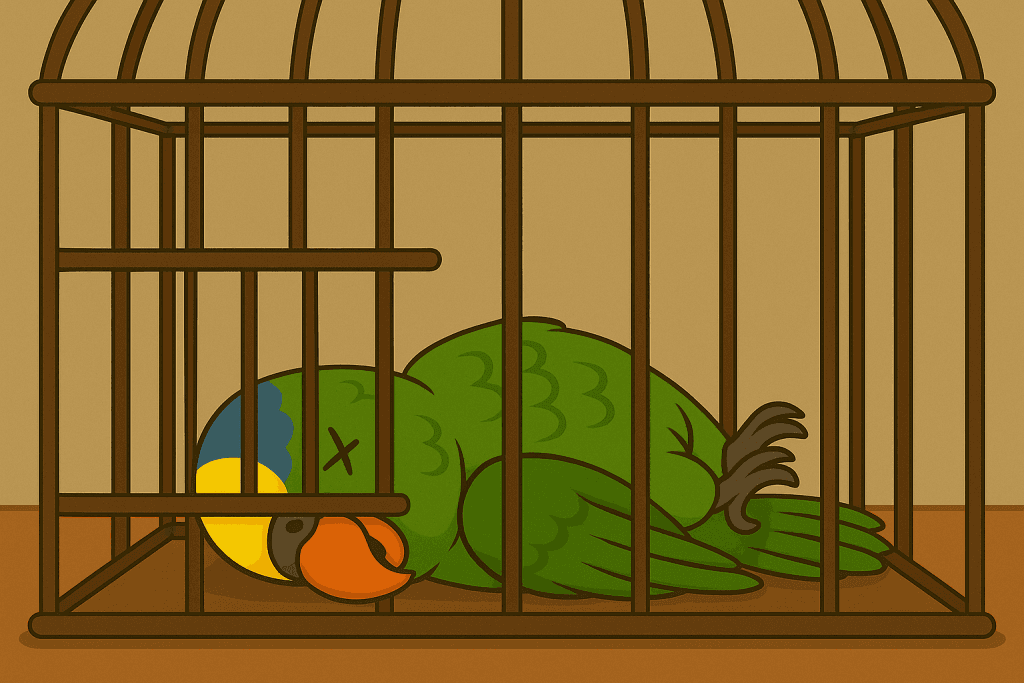
But that happiness didn't last. One night I heard her crying. In her desperation to get out of the cage, she had pushed her head through the wire, and when she tried to pull it back in, she broke her neck. I heard her voice almost gone and went to the patio to see what had happened. I found her on the floor of the cage, dying, until she was gone. The pain of seeing her like that still shakes me to this day.
Knowing I had lost someone so important to my family simply because she was kept in a cage left me breathless — and left me grieving through my adolescence. That night I understood that birds are not meant to live locked up. They are meant to be what they are, in freedom: to fly, to spread their wings, to share their lives with others. I never got to see her grow beyond what she was, but today I picture her flying free over the hills and mountains — landing on rooftops, living her life with other parrots in the open air.
Analysis and reflections from Fundación Loros
That early loss left a void in Francys, but it also lit an ethical compass inside her.
A cage, at first glance, can look like shelter: an enclosed space that contains, protects, and makes care easier. But inside that enclosure, the bird's essential instinct is also enclosed: flight. The cage, with its bars and its false sense of security, becomes a trap where many birds end up injured, desperately trying to escape the confined space. Some are left forgotten in the sun, without water or shade, while their owners are away or face an unexpected crisis; others are found too late, already dead, tangled in their toys, searching for relief that captivity never allowed.
The lesson is clear: an animal built to cross the sky does not belong in a metal box. Every bird that dies in a cage reminds us of the fragility of its existence and the serious mistake we make when we replace branches and open sky with bars. Before deciding to keep a bird at home, it's worth asking: how fair is it to strip a living being of its essential freedom?