Wildlife feeders: a bridge to freedom or a magnet for danger
A feeder is neither good nor bad. What decides its value is the direction in which it pushes the animal.
By Alejandro Rigatuso, founder of Fundación Loros · Villanueva, Bolívar, Colombia · July 30, 2026
The mistake of asking the wrong question
Every so often someone writes to us with the same worry: isn't it contradictory for a foundation that wants to return parrots to the wild to feed them? And from the other side, just as often, someone asks us whether they should put a feeder on their farm to "help wildlife."
Both questions rest on the same mistaken assumption: that feeding wildlife is, in itself, either a good thing or a bad thing. It is neither. The scientific literature of the past two decades is emphatic on one point and ambiguous on nearly every other: the same device — a tray of food — produces opposite outcomes depending on who you put it out for, where, at what time of day and for what purpose.
The useful question is not feed or don't feed? The useful question is:
Is this feeder moving the animal from captivity toward freedom, or from freedom toward the human world?
That is the axis. Everything else — hygiene, type of food, number of stations — matters, but it is secondary. An impeccable feeder pointing in the wrong direction is still a problem.
The distinction that orders everything: which way does it point?
The uses of a feeder fall into three clear categories. They are not told apart by the apparatus, nor by the food, nor by the species. They are told apart by the direction of travel.
1. The bridge — from the cage to the forest
The animal comes out of captivity. It cannot fly well, it does not know the territory, it does not know where to find water, it has never seen a fruiting tree from its own region. The feeder is what buys it time to learn without starving in the attempt.
The sequence is:
animal in captivity → rehabilitation inside aviaries → outdoor feeder → freedom with a safe harbor → progressive exploration → navigation → discovery of natural food sources → decreasing dependence
Every arrow in that chain points outward, toward the forest.
Two effects that work together
It is worth pausing on why that chain works, because the feeder does two things at once. The first is the harbor. The bird leaves in the morning, goes a little farther each day, tries a new branch, gets it wrong, and by late afternoon returns to a place where it knows there is water and food. Exploration stops being an all-or-nothing bet: the bird can risk the long flight because it has somewhere to come back to if the forest has not fed it yet.
The second is the anchor. While the body is still coming into condition — as flight grows stronger and reactions quicker — the feeder keeps the bird near familiar ground and away from the places where it would not yet know how to defend itself: the denser bush with more predators, the edges where humans turn up. It does not confine the bird; it gives it a center of gravity that pulls less and less as the bird becomes more independent. The same device performs both functions at once: it sustains and it protects.
A window for watching without chasing
There is a third effect, and this one is for us. When the flock gathers at a known point, we can read it without chasing it: count how many arrived, recognize each individual by its tag, confirm who came back and pick up early on a bird that is ailing or injured. The feeder turns a release into something we can follow closely, instead of letting go and hoping.
That window does not solve everything — further on I come back to what a bird that stops showing up still does not let us claim — but it sharply reduces the part that used to be blind. And it is that reduction that lets us speak with data.
The evidence backs this clearly. The review of 47 psittacine reintroductions in nine countries identified the duration of supplementary feeding as one of the consistent predictors of success, alongside predation pressure at the site and habitat quality. Withdrawing food too soon is one of the avoidable causes of failure.
Our own data, peer-reviewed in Bird Conservation International, point the same way. In the release of 18 young Amazona ochrocephala parrots, confiscated from the trade and prepared with free-flight training: 72% were still alive at one year, 94% at one month, 89% at three months. 100% of the birds used the feeders, with 100% flock cohesion and 94% site fidelity.
Those figures do not describe dependent birds. They describe birds that had somewhere to return to while they learned the forest. And what came next says everything: our parrots found local trees on their own — guásimo, hobo, palma de vino, mamoncillo, ciruela criolla. They developed a preference for rosa amarilla (Cochlospermum vitifolium), a tree they had never seen in captivity. The aviary prepares the body; the forest teaches the rest. The feeder is what sustains the bird through the lesson.
2. The magnet — from the forest to the house
The animal is fully wild. It already knows how to feed itself, it already knows its territory, it already has a map that works. The feeder teaches it nothing: it rewrites the map, and rewrites it in the direction of danger.
The sequence runs the other way:
competent wild animal → feeder near humans → change of routes → loss of wariness → road, dog, power line, conflict
A fox, a raccoon or a deer that learns there is predictable food near houses begins to cross roads and to lose the wariness that kept it alive. Death on the road is not a side effect: it is the expected consequence of having shifted the animal's center of gravity toward us.
In ecology this has a name: ecological trap. A place the animal reads as good — there is food, it is predictable — but that in fact lowers its survival. The animal chooses badly because we gave it a false signal.
Here there is nothing left to learn that would justify the risk. There is only a change in behavior that does not benefit the animal.
3. The diversion — from conflict to calm
The animal is wild and competent, but its behavior is creating a problem: it preys on a threatened species, it gets into a crop, it comes near a henhouse. The feeder goes in far from the point of conflict, to take the pressure off.
animal in a conflict zone → alternative food far away → less pressure on the problem resource → conflict resolved without killing anyone
It is the least known use and one of the best supported. In Scotland, food was offered to pine martens and badgers to reduce predation on capercaillie nests, and the effect was measured in two stages. First with artificial nests: estimated survival across the 28 days of incubation rose from 40% to 74% where diversionary feeding was in place. Then, with real clutches, the effect on the population was measured: capercaillie productivity rose from 0.82 to 1.90 chicks per hen.
The feeder works here precisely because it moves the animal away from the problem area, not because it draws it closer. Same rule as the bridge.
The matrix, in one table
| Bridge | Magnet | Diversion | |
|---|---|---|---|
| Who it is for | Ex-captive animal, without ecological competence | Wild animal, fully competent | Wild animal in a conflict zone |
| Direction | Captivity → freedom | Freedom → the human world | Conflict → neutral ground |
| What it provides | Time to learn the territory | Nothing the animal needs | An alternative to the contested resource |
| What it trains | Wild behaviors: height, flight, foraging | Risky behaviors: coming down, approaching, waiting | Nothing new — it only relocates what the animal already did |
| Location | Release site, far from roads and houses | Near homes or roads | Far from the point of conflict |
| What ends | Each bird's dependence, on its own | Nothing — there is no process, only habit | The pressure on the contested resource |
| Verdict | Justified | Harmful | Justified |
The second direction: upward
So far we have discussed direction in the horizontal sense: whether the feeder brings the animal closer to the human world or moves it away. But there is a second axis, and it is vertical.
A feeder does not only feed: it trains. Every time an animal goes to eat, it repeats a movement, a posture, a height, a schedule. That repetition leaves a mark. So the question does not end at where am I moving it to? — it continues into what behavior am I teaching it while it eats?
And here is the criterion we consider decisive: a feeder must lead the animal toward its natural behavior, not away from it. A feeder that requires coming down to the ground trains an arboreal bird to be on the ground. A feeder that can be reached on foot trains it not to fly. A feeder at a person's height trains it to tolerate human proximity. None of those behaviors serve the animal later on.
How we apply it: the height ladder
With parrots and macaws, this translates into something very concrete. The stations rise along with the process.
We start with feeders hung from trees at 3 or 4 meters — a height that a bird just out of the aviary can reach with confidence, without becoming frustrated or staying low. As the flock gains flight strength and assurance, the stations are raised progressively: 7, 8, 10, 12 meters.
The effect is twofold, and both sides matter:
- Protection. The higher the bird, the farther it is from ground predators, from dogs, from cats and from the movement of people. Height is shelter.
- Behavior. A parrot that eats at twelve meters is a parrot that flies high to eat. It gets used to operating in the canopy, which is exactly where a wild psittacine lives: where the fruit is, the water-holding cavities, the roosts and the resident flocks. Flights become higher because the food is higher.
Seen this way, the feeder stops being a plate and becomes an instrument of behavioral shaping. We do not ask the bird to climb: we put the food where we want the bird to learn to be, and let its own motivation do the rest. It is the same logic that runs through our entire method — building capabilities instead of imposing behaviors, and using the animal's instinct in favor of the process rather than against it.
And note that this ladder solves, along the way, much of the magnet problem: a station twelve meters up in the forest canopy is simply out of reach for a fox, a dog or a curious passer-by. Raising the feeder means training better and risking less at the same time.
On video
The feeder in action
This is what a feeding station looks like when it works as a bridge: a wild animal comes in, feeds and goes back to the forest. The feeder supports the transition to life in the wild; it does not replace it.
The real risks, and how they are managed
No serious program installs a station without knowing its risks. There are three, all well documented, and all three have an answer in the design.
Concentration and disease
When food is concentrated at a fixed point, animals concentrate with it, and their pathogens along with them. A review of 115 studies covering 68 species identified three pathways of risk: more contact between individuals, pathogen buildup at the station, and contaminants in the food itself. The best-known case occurred in British gardens, where trichomonosis transmitted at feeders cut the greenfinch population by roughly two thirds between 2006 and 2016 — the largest impact of an infectious disease ever recorded in British birds.
The full nuance is worth stating, because it usually gets left out: the leading meta-analysis on the question concluded that the results are highly heterogeneous. Risk climbs sharply with neglected stations and porous surfaces that go uncleaned; with rigorous hygiene, the picture is very different.
How we handle it. At Fundación Loros we use stainless steel trays, not wood or plastic: steel does not absorb, does not hold organic matter in pores or cracks, and can genuinely be disinfected. Trays are changed twice a day. In a climate like that of the tropical dry forest — humid, hot, with fungi that colonize exposed fruit within hours — that frequency is not overkill: it is the minimum. Most of the literature on feeder hygiene comes from temperate regions and falls short for the tropics.
The station that turns into a magnet at night
This is the subtlest risk, and the one that concerns us most. The same object can be a bridge by day and a magnet by night. A platform left stocked with fruit at dusk stops being release infrastructure and becomes a point of attraction for opossums, raccoons and other nocturnal wildlife, which learn the location, work it into their route and start frequenting a place with a human presence.
How we handle it. Trays are taken down in the afternoon. No food is left out overnight. The station exists for the birds in the process of being released, and only during the hours those birds use it. Outside that window, there is no station. It is the most direct operational answer to the question underlying this article: you can build a bridge without building a magnet, but you have to decide it in the design.
On top of that, the stations are elevated, in trees: away from the ground, from terrestrial predators and from human traffic.
Inadequate food
The third risk is slower: animals that eat something abundant but incomplete and lose body condition without anyone noticing. In other latitudes the classic example is the ground meat people offer to urban birds — filling, but it strips calcium. More serious cases have also been documented, such as European vultures that accumulate pharmaceutical residues after feeding on recently medicated livestock.
How we handle it. A natural diet: local fruit and seeds, the same base the bird will find in the forest. Never human or processed food. A feeder should not teach a taste the territory cannot satisfy afterwards.
The criteria that separate one case from the other
If we had to reduce all of this to a checklist to run through before installing a station, this would be it.
1. Who am I feeding? An animal that does not yet know how to survive, or an animal that already does. Feeding the first is teaching; feeding the second is interference.
2. Where am I moving it to? If the station brings the animal closer to roads, houses, dogs or unfamiliar people, it is in the wrong place, period.
3. Who can reach it, and when? A station used only by the animals it was built for, within a bounded time window, is infrastructure. A source open to any species at any hour is a magnet, however good the intention behind it.
4. What behavior does it train? If eating at the station requires the animal to do something close to what it will do in the wild — fly, climb, search up high — the feeder is working in its favor. If it requires the opposite — come down, walk, wait near people — it is training the animal to fail.
5. What am I measuring? Without monitoring there is no way to know whether the feeder is working as a bridge or as an anchor. We measure station use, site fidelity, wild foraging and individual survival — every bird wears its own tag.
An important clarification: we do not remove the feeders
There is something here that is often misread, and it is worth stating precisely.
Many programs speak of "gradually withdrawing the food" as the closing step of the process. We do not do that. The stations stay. What happens is different and, we believe, better:
The birds leave on their own. As new cohorts enter the process and as each bird finds its own natural food sources, its use of the station declines by its own choice. Nobody takes the plate away. The bird simply stops needing it.
This is consistent with the central principle of our method: the progressive dilution of dependence. Just as we do not induce fear of humans — distance emerges when the bird develops its capabilities and forms bonds with its flock — neither do we force independence from the feeder by taking the food away. Independence is not imposed: it is reached, and it shows.
It also has a practical consequence that resolves an apparent tension in the literature. On one side, the general wildlife-feeding literature warns against feeding indefinitely. On the other, the review of psittacine reintroductions finds that the longest supplementation periods are associated with greater success — the group of twelve months or more is the one with the best results — and that withdrawing food too early makes releases fail.
It is not a real contradiction: it is, once again, a difference of direction. Feeding a self-sufficient wild population indefinitely creates dependence where there was none. Sustaining a station for a continuous flow of birds coming out of cages builds autonomy in every one of them.
That is why a visitor who sees a full feeder is not looking at dependent parrots. They are looking at the scaffolding for the next group. The station is permanent; each bird's dependence is not — and that last part is what we measure.
One final nuance, in the interest of honesty: a meta-analysis of 201 experiments across 82 studies on birds found that supplementary feeding improves reproduction, but with little effect when natural food is already abundant. At the peak of the fruiting season the marginal contribution of a station is smaller than in March, in the middle of the dry season. Seasonality is not a detail: it is part of the design, and it explains why our optimal release window runs from May to July.
How we do it, in practice
- Stations hung from trees at increasing heights: we start at 3–4 meters and move progressively up to 7, 8, 10 and 12 meters as the flock gains flight capacity. For the exclusive use of the birds in rehabilitation.
- Stainless steel trays, changed twice a day.
- Trays removed in the afternoon. No food overnight.
- Water dishes beside the stations during the exploration stages. In tropical dry forest, finding water is as critical as finding food: our birds drink from tree cavities, but only once they have built their mental map. The water dish sustains that exploration.
- Natural diet: local fruit and seeds. Never human or processed food.
- Individual monitoring by tag, community reports, and a record of who uses the stations and who no longer does.
When we intervene
- Sick or emaciated birds turning up at the station → full disinfection and immediate health check.
- A bird showing no progress toward wild foraging → we review that bird's individual process, not the station.
- Evidence that the station is attracting non-target wildlife → relocation and adjusted schedules.
- Birds that seek out people for company rather than out of hunger → they go back to earlier stages of the process.
And what does Colombian law say?
Less than you would expect — and the little it does say sits in a place worth looking at closely.
Colombia has no general rule governing wildlife feeders. There is no permit to request and no procedure to complete in order to install one. But two express prohibitions on providing food to animals do exist, both in Decreto 1076 de 2015 (Colombia's environmental decree): one for territorios fáunicos, or wildlife territories (article 2.2.1.2.20.6, numeral 5), and another for the areas of the Sistema de Parques Nacionales Naturales, the National Natural Parks System (article 2.2.2.1.15.2, numeral 11).
It is worth noting where it prohibits. In the areas where wildlife is fully wild and self-sufficient. In other words: Colombian law forbids feeding in exactly the magnet scenario, and says nothing about all the rest.
One note, because the mistake circulates often: article 2.2.1.2.25.1 is frequently cited as the rule that "prohibits feeding wildlife." That article says no such thing — its ten numerals deal with hunting conduct: burning, poisons, destruction of nests, hunting during closed seasons. The prohibition does exist, but it lives in the two articles cited above, and with the delimited scope established there.
What is regulated is release. Resolución 2064 de 2010 (Colombia's resolution on the handling of seized wildlife) expressly recognizes soft release as one of the valid ways of returning an animal to the wild, and requires that releases be carried out with the competent environmental authority. Our stations are not a free-standing initiative: they are part of a process accompanied by CARDIQUE, within the Red de Amigos de la Fauna Silvestre (Friends of Wildlife Network).
In the end, the legal distinction looks a lot like the technical one. Feeding inside an authorized process has backing. Feeding on your own, outside those areas, is not prohibited — but it is not protected either: if it causes harm, whoever did it answers for it.
That is why we wrote these criteria down. Where the law is silent, someone has to put a proposal on the table.
And what if the objection is that we should not intervene at all?
There is one objection that deserves respect, because it comes from a sound instinct: nature usually sorts itself out better when we leave it alone, and almost every time we lay a hand on it we end up making things worse. I share the substance of that intuition, and I have seen too many human favors end in harm. But applied to the feeder, that idea rests on an assumption that does not hold: that what we have in front of us today is an intact forest we could, with discipline, abstain from touching.
The truth is that we already intervened, and we did it by destroying. We razed entire forests to put up a neighborhood, and we felled the tree where a family of parrots found shelter and food. Asking them now to move and find food right away somewhere else is an absurd demand: there is no empty place waiting for them, and the clock of their hunger knows nothing about housing developments. We were the ones who displaced them, and then we asked them to solve on their own a problem we created.
That is why I do not think the honest answer is to do nothing. If we were the ones who pushed them into living near cities, it also falls to us to help them inhabit a reality they did not choose. Humans not only can intervene: we must, but in the direction opposite to the one that caused the harm. Refusing to intervene, after destroying the habitat, is not prudence; it is leaving the damage half done.
We already intervened when we cut the forest down. What is left to decide is not whether we lay a hand on it again, but which way we move that hand.
And here the thesis of this piece comes back intact. Recognizing that we must intervene does not authorize us to put food anywhere we please, or to accustom a competent animal to our presence. A badly conceived feeder next to houses is still a trap, however good the intention behind it. Intervening well is not intervening a lot; it is doing it with a clear objective and in the right direction: moving the animal toward freedom, not toward our world. And knowing whether a feeder does that requires, once again, the same question we started with.
The final question
Everything above can be compressed into a single question, and it is the one we suggest asking of anyone thinking about putting up a feeder. It is not "feed or don't feed," but something more demanding:
What is the objective of this feeder, and what is its real impact? Does it produce a net positive benefit for the individual, for the population that individual belongs to, and for the ecosystem both inhabit — and not only for the entertainment of whoever installed it?
All three scales matter, because they rarely point in the same direction. A feeder can save an individual and harm its population, concentrating disease or distorting the dynamics of the species. It can benefit a population and still alter the ecosystem that population depends on: it draws scavengers, subsidizes a competitor that ends up displacing other species, concentrates pathogens at a point where they never used to gather. And it can look impeccable at the scale of the ecosystem while exposing some individuals to a risk they never chose. A serious program answers for all three.
In our case the answer is specific and bounded: we feed birds that came out of cages, at the site where we released them, in steel trays that are changed twice a day and taken away before nightfall, for as long as each bird needs in order to learn a forest it never knew. We do not take the plate away: we wait for them to stop coming. Our measure of success as caretakers is to make ourselves progressively expendable.
Releasing is not the same as letting go. And feeding, properly understood, is not the same as giving food: it is sustaining a learning process until it is no longer needed.
In pictures
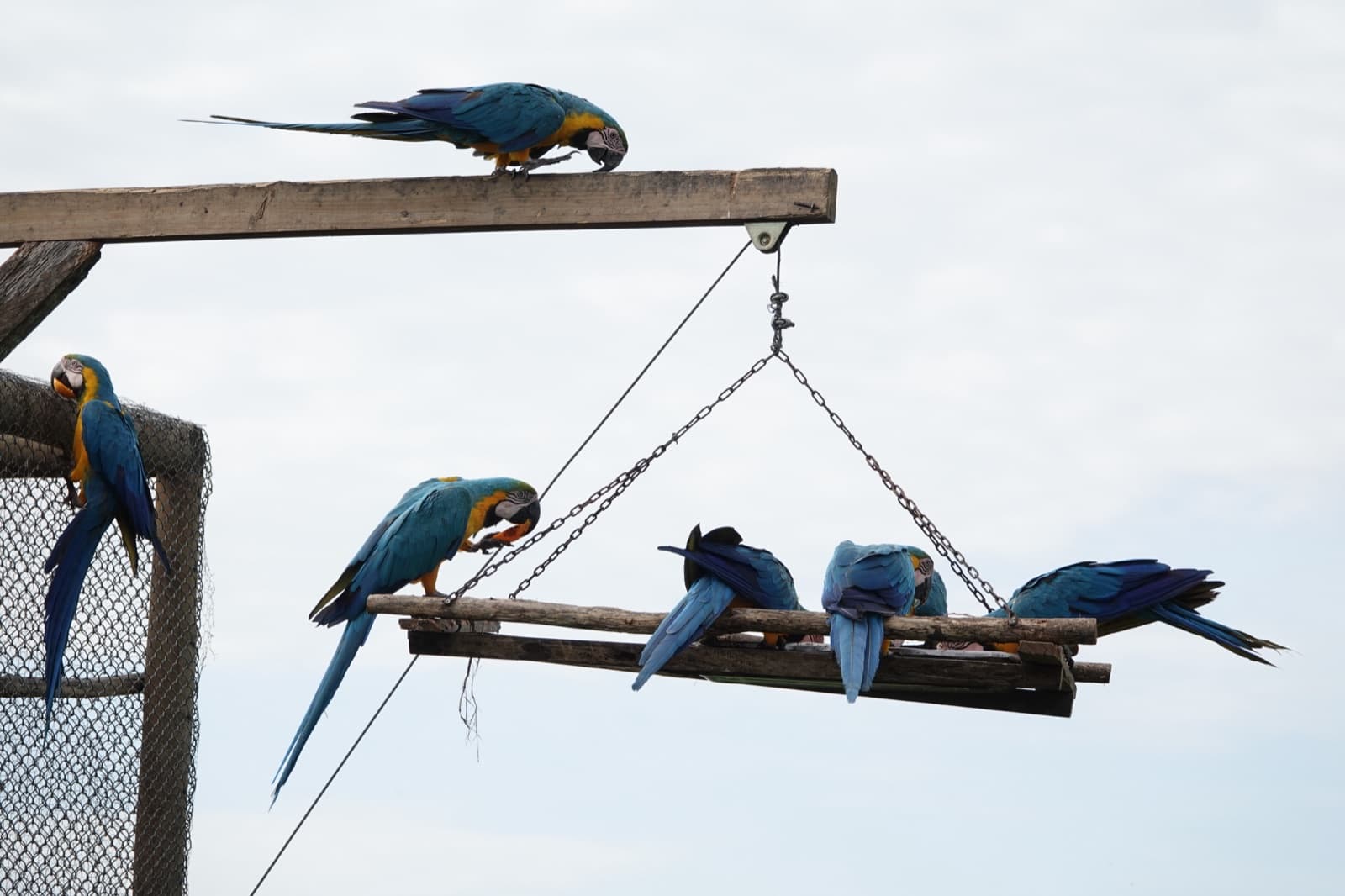
The reserve's feeders
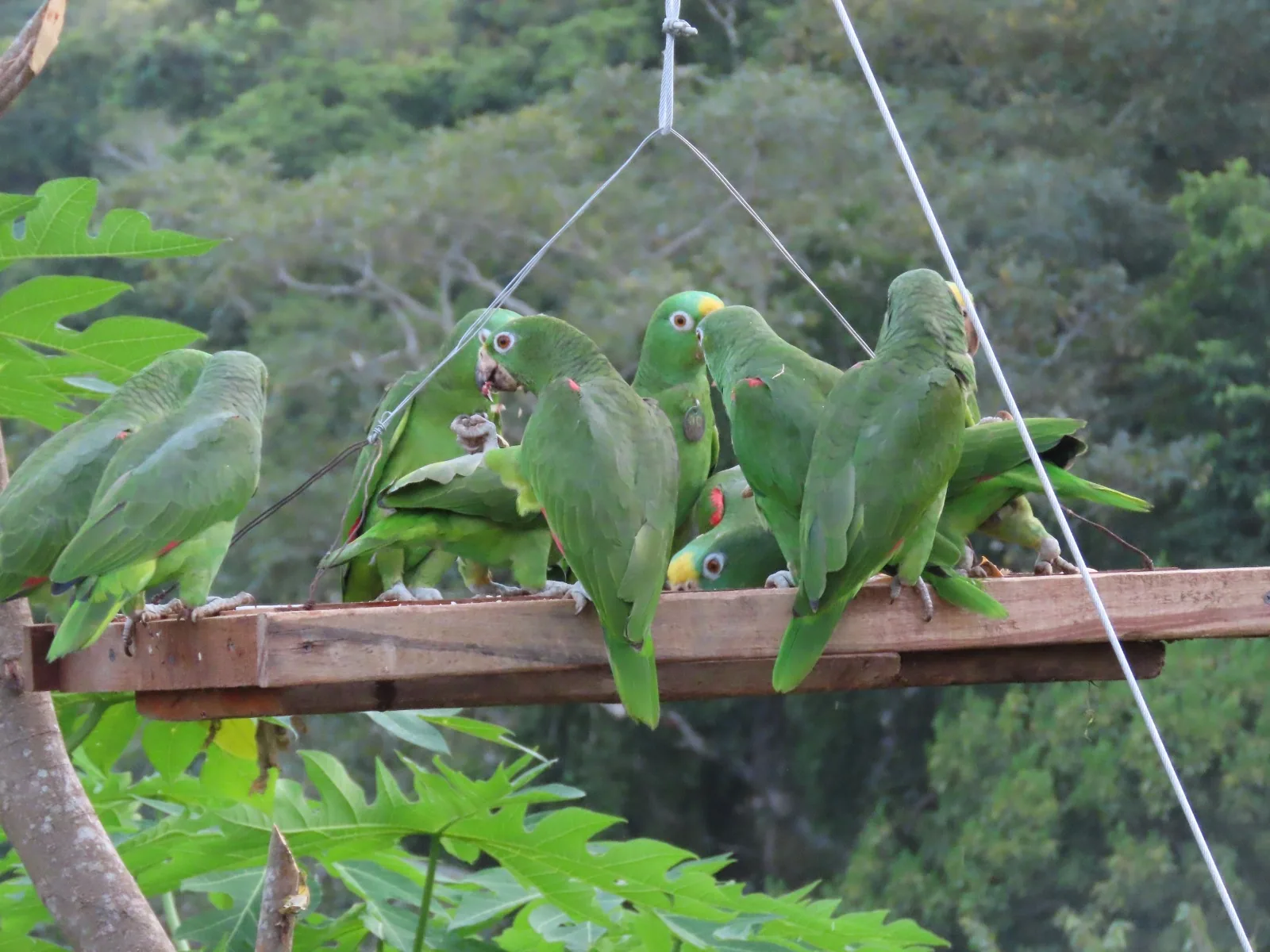
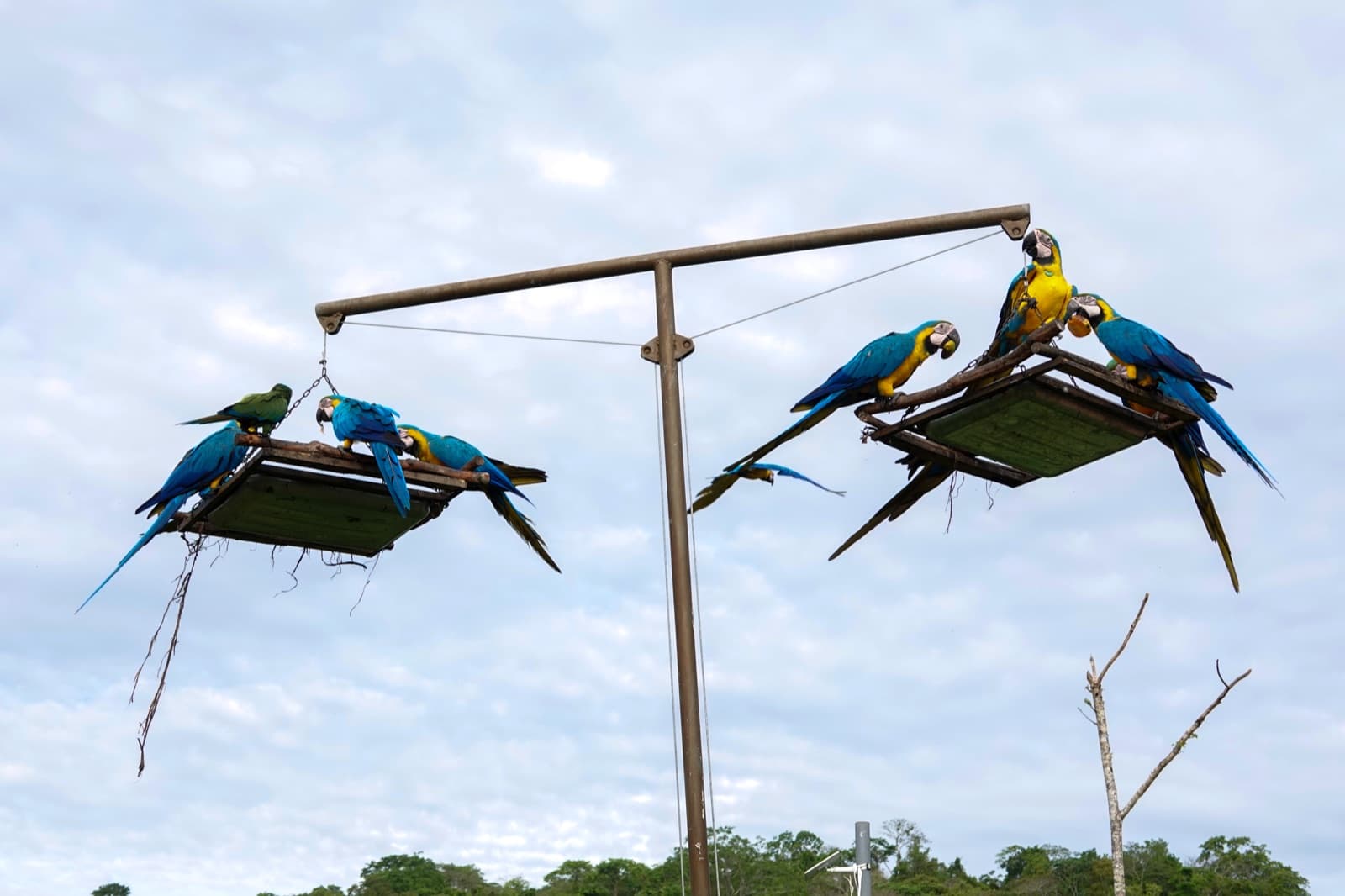
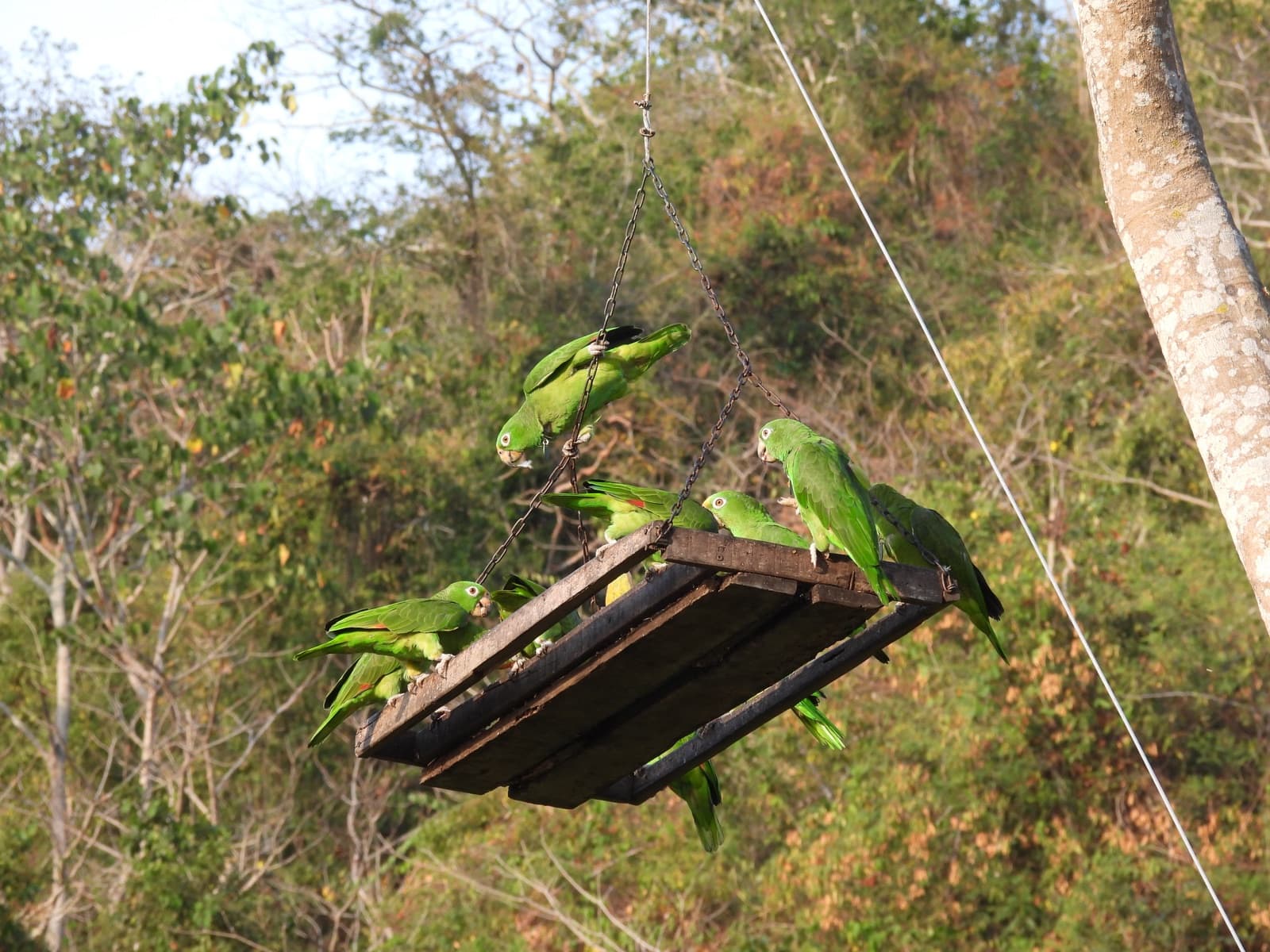
Stations hung from the trees, several meters off the ground, where animals going through reintroduction find temporary support while they recover their autonomy.
What we still do not know
This text, like our method, is a living document. There are things we would rather state outright than merely imply:
- Most quantitative studies on wildlife feeding come from temperate regions. Transferring them to the humid tropics is not automatic, and it probably underestimates the risks from fungi and from competition with common species.
- When a bird stops coming to the station, the optimistic reading is that it found the forest. Telling that reading apart with any certainty from the alternatives — dispersal, undetected mortality — demands finer monitoring than any program has today. It is the main open question in our model.
- The height ladder of the stations (3–4 m up to 12 m) is a field criterion, not a published result. The principle — that height protects, and that behavior is shaped by where the resource sits — is well founded; the exact progression, the timing and the optimal ceiling are ours, and we hope to be able to measure them.
- Our figure of 72% at one year corresponds to a single cohort, of young birds, at a site with low-to-moderate predation pressure. It is a high result for a reintroduction with no prior wild population, but it is one point, not a curve.
We share this openly so that it can be discussed, criticized and improved. Conservation advances faster when knowledge is shared than when it is kept.
Key references
- Becker, D. J., Streicker, D. G., & Altizer, S. (2015). Linking anthropogenic resources to wildlife–pathogen dynamics: a review and meta-analysis. Ecology Letters, 18(5), 483–495.
- Murray, M. H., Becker, D. J., Hall, R. J., & Hernandez, S. M. (2016). Wildlife health and supplemental feeding: A review and management recommendations. Biological Conservation, 204, 163–174.
- Ruffino, L., Salo, P., Koivisto, E., Banks, P. B., & Korpimäki, E. (2014). Reproductive responses of birds to experimental food supplementation: a meta-analysis. Frontiers in Zoology, 11, 80.
- White, T. H. Jr., Collar, N. J., Moorhouse, R. J., et al. (2012). Psittacine reintroductions: common denominators of success. Biological Conservation, 148(1), 106–115.
- Brightsmith, D. J., Rigatuso, A., Biro, C., & Geiszler, D. (2026). Successful release of confiscated Amazona parrots using free-flight training. Bird Conservation International, 36, e24.
- Bamber, J. A., Sutherland, C., Kortland, K., & Lambin, X. (2024). Evaluating diversionary feeding as a method to resolve conservation conflicts in a recovering ecosystem. Journal of Applied Ecology. https://doi.org/10.1111/1365-2664.14693
- Bamber, J. A., Sutherland, C., Kortland, K., & Lambin, X. (2025). Empirical evidence that diversionary feeding increases productivity in ground-nesting birds. Proceedings of the Royal Society B, 292(2049), 20242921. https://doi.org/10.1098/rspb.2024.2921
- Robinson, R. A., Lawson, B., Toms, M. P., et al. (2010). Emerging infectious disease leads to rapid population declines of common British birds. PLoS ONE, 5(8), e12215. https://doi.org/10.1371/journal.pone.0012215 — together with the later follow-up work by Lawson et al. and by Garden Wildlife Health / British Trust for Ornithology.
- Blanco, G., Junza, A., Segarra, D., Barbosa, J., & Barrón, D. (2016). Wildlife contamination with fluoroquinolones from livestock: widespread occurrence of enrofloxacin and marbofloxacin in vultures. Chemosphere, 144, 1536–1543. https://doi.org/10.1016/j.chemosphere.2015.10.045
- Ewen, J. G., Walker, L., Canessa, S., & Groombridge, J. J. (2015). Improving supplementary feeding in species conservation. Conservation Biology, 29(2), 341–349. https://doi.org/10.1111/cobi.12410
Fundación Loros · Reserva Los Loros, Villanueva, Bolívar · Tropical dry forest
Non-profit entity · NIT 901.597.480-2 · Red de Amigos de la Fauna Silvestre de CARDIQUE
Learn about our method · info@loros.org
Open review
Reviews of this article
This text gets corrected with input from the field. You can review the whole article below, or scroll back up and flag a specific paragraph while you read. We read every submission before publishing it.
This article has no published reviews yet. If something you read contradicts your experience, misses a nuance, or you can add to it from your own fieldwork, write it here: we read all of it.
Leave your review
You can review the whole article from here, or flag a specific paragraph while you read.