The Spirit of the Parrots
Not printed yet
Leave your details and we'll write to you as soon as the book exists on paper.
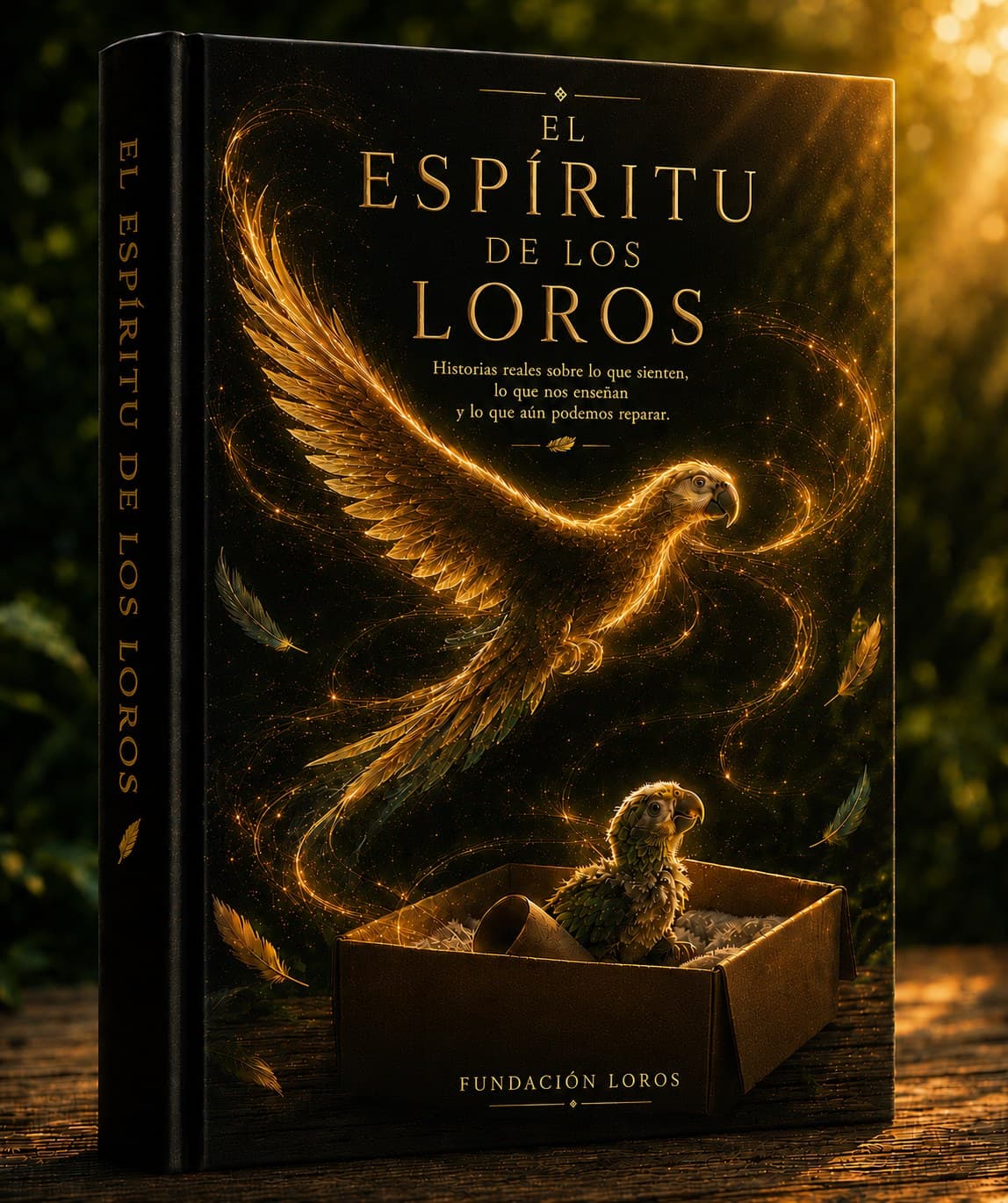
The Spirit of the Parrots
Ten true stories from Colombia. In every one there was a parrot. In every one, someone opened their hand.
At five in the afternoon, over Leticia, the Amazonian sky fills with wings.
Thousands of parrots circle above the park's palm trees. They are not fleeing or searching for food: they are calling to one another. Each one has a name—a vocalization its mother sang to it at birth, one that will never be repeated anywhere in the world—and at this hour all of them say their name at the same time. It is an enormous sound. It resembles the laughter of a thousand people. Afterward they settle in and sleep together, and tomorrow, again.
That is where it comes from.
It does not come flying, because it has no wings. It comes the way the smell of a split fruit comes: it goes with the air, with no one deciding anything, and the air carries it far.
When a parrot does not fly—any parrot, one of the millions that have not flown since there have been cages—it feels it. Not the way an adult feels it, who already knows the procedure and knows where to put the thing away. It feels it the way a seven-year-old child feels it on the night it understands, lying in bed, with no one having told it and with nothing having happened, that its mother is going to die someday.
That abyss that opens beneath the bed.
It has happened to it millions of times. It is always the first.
And it does not speak. It is useful to be clear about this from early on, because it is what separates it from everything that resembles it: it does not ask, does not reproach, does not threaten, does not promise. It does not appear to anyone bearing a message. It does not bring a list of things it wants us to do.
It does one thing only, and it does it in passing, without stopping.
When it brushes against a person, that person feels what the bird in front of them feels.
One second.
There is no vision. There are no forests, no flocks, no voice saying anything. It is simpler than that, and worse: for one second that person's body knows what it is to have been born to cross an entire valley before breakfast and to have spent five years on a forty-centimeter perch.
Then it is over and the room is a room again.
But there are things a person cannot stop knowing once they have known them.
Those who have felt it do not agree on what it is.
Some call it the spirit of the parrots.
The ten stories that follow are from Colombia, written by ten different people who have never met. A yard in Antioquia. A rural classroom in Vichada. Not one of them was written with a spirit in mind.
In every one of them, for a second, it was there.
Where it has been
«Between wires and sky your emerald flight fell.»
«Rina escaped, Rina escaped! the farmhands were shouting.»
«Marco Polo always looked at me in his own way: steady and still.»
«From the time I was a girl, parrots were always my favorite animal.»
«In January 2024 I landed in Vichada to work as a rural teacher.»
«We lived in a small apartment, the four of us.»
«From as far back as I can remember, I always wanted a parrot as a companion.»
«My dad is just a farmer from Santander who was once captured and caged.»
These ten stories were written separately. People who have never met, in different years, each one certain that what had happened was a private matter between her and a bird.
They don't all end well, if well means what we want it to mean. Rina never got the forest back. Paco was left with a broken wing.
But the same thing happens in all ten, and it is the only thing that happens in all ten: someone lets go.
That is all it takes. You don't have to understand anything, or sign anything, or become another person. The hand only has to open.
Where each of those birds went afterwards, the stories don't say.
Some of them, perhaps, came here. The ones that were seized, or the ones somebody handed over to the authorities: that is the door, and it isn't yours to open. An environmental authority opens it, and it is the authority that decides where the animal goes.
The ones that arrive stay for months. They eat fruit they don't recognize. They learn again that a branch moves.
And one day the carrier opens and nothing happens. And a while later it does.
The ones that stay up there find someone who was already there.
The first of all of them. The first to arrive, and among the last to leave.
Not because he wasn't ready. He may have been ready from the first day. The one who wasn't ready was the one who had to open the door.
Here, too, we had to learn to let go. And you don't learn it by loving hard: loving hard is how never letting go gets justified. You learn it by measuring. How many meters he flies without resting. Whether he recognizes a fruit nobody taught him. What he does when a large shadow passes overhead.
Until the numbers say what the affection didn't dare to.
His name is Beethoven. In the foundation's records he is number fifteen, because when he arrived there were no records.
He arrived on Tuesday 5 March 2019, in a cardboard box, as a gift.
A green and yellow chick from the Bazurto market, one of those offered to whoever walks past. They gave him to Alejandro, an Argentine who had been living in the city for a while, who knew nothing about parrots and didn't even know that keeping one was illegal.
At the exact moment the box was opened, the wind came in.
Not a breeze. Wind. Furious, like a storm, in an apartment in the El Cabrero neighbourhood.
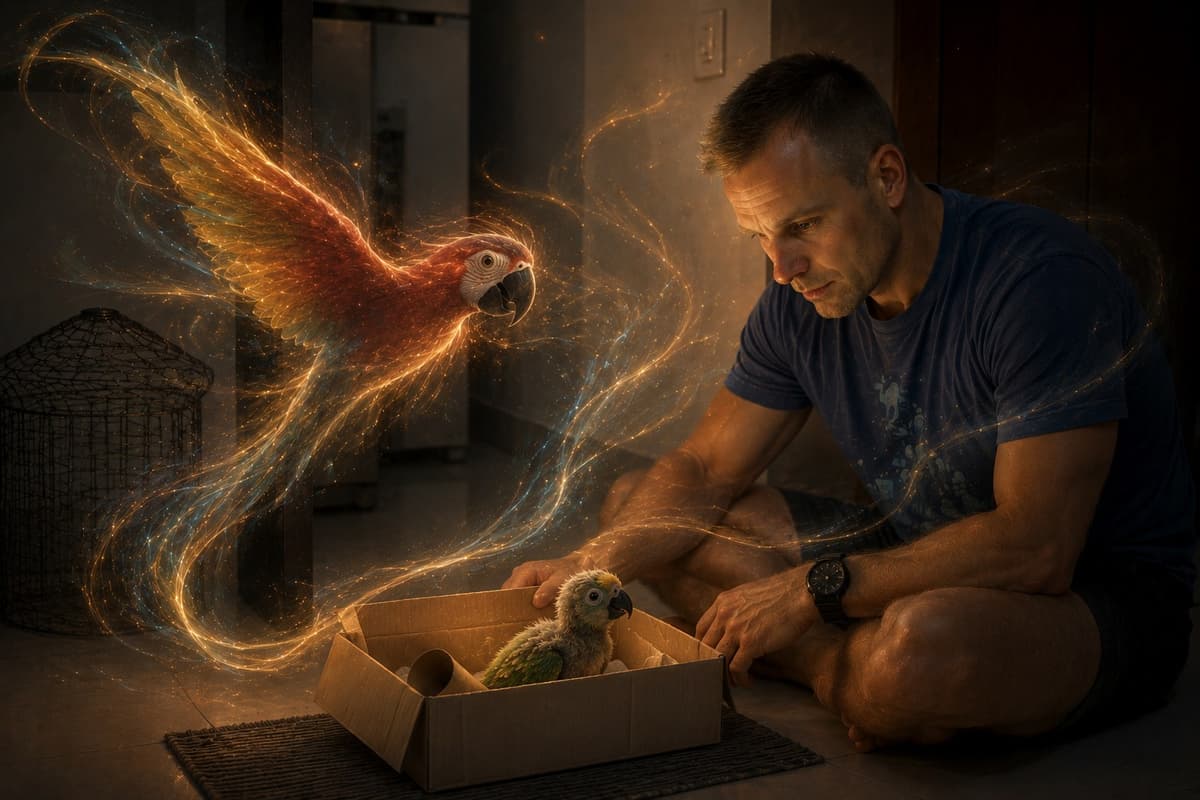
That was the beginning of Fundación Loros.
But that story is for the second season.
Nobody wrote this.
The Day I Saw Them
I arrived in Villanueva on a Tuesday, on a north wind that came in dry and smelling of dust, and the first thing I found was mesh.
Green mesh, pulled taut, high. Inside, birds. I counted twelve and stopped counting. I slipped in through the gaps the way I slip in everywhere, and got to work.
There was a man standing there with a bucket. Alberto. I brushed him.
Nothing happened.
That had never happened to me. I don't fail: I brush someone and that person knows. I did it again, slower, with the stillest bird I could find, an amazon with the feathers of her chest broken from plucking them out herself. I passed Alberto what that bird knew was hers —the air over the feathers, the name her mother sang to her that she has never heard again from anyone— and he went on measuring fruit into the bucket.
He already knew.
It took me the rest of the morning to understand. I went one by one. Carlos, writing in a notebook. The one sweeping. Omar, up a pole, setting a wooden box into the fork of a tree. They all already knew. I didn't need to show them anything, because they had spent years standing inside it.
And the mesh was not a cage. It cost me to admit it, because to me all mesh is the same; I don't tell them apart, I have spent millions of years going in and out of one single thing. But inside there were thick branches and real wind and other birds, and up was also a place to go. It was a cage turned inside out: not to keep them from leaving, but so they would learn how.
So I stayed.
That, too, I had never done. I go where the wind takes me and the wind never stops, but that Tuesday the air stood still over the dry forest all afternoon and I had nowhere to go and no one to brush. I spent four days there, with no trade, watching how the ones with hands work.
Hands weigh fruit. Hands write down in a notebook what time each one ate. Hands climb a tree and nail up a box so that someday a pair might lay eggs there. Hands open and close the door of the mesh twice a day and never get it wrong, because getting it wrong once would mean releasing a bird that doesn't yet fly.
I have spent millions of years standing next to a lock. There were eight people there who spend their days opening and closing them with a patience I cannot hold. That's why I stayed, I think. The way you sit down to watch someone do the one thing you cannot do.
On Saturday there was wind again, and something more.
They took seven out of the big mesh and moved them to a smaller aviary, right up against the forest. They stayed there a few days, listening to the woods up close. Then, early one morning, Alberto opened the door and stepped aside.
Nothing happened for a long while. It's a lie, that they shoot out. They came out walking along the branch, one, and then another, and they stood there looking at the whole world without making up their minds.
I moved close to Alberto. I don't know why. I had nothing to give him.
And I brushed him.
What I passed him was not the usual thing. There was no captivity inside the bird. There was a body of three hundred grams, hungry, about to go into a forest it doesn't know, knowing perfectly well how it's done and never having done it. Fear and muscle at the same time. The exact thing you feel at the edge of a diving board, if the diving board were what you were born for.
One second.
Alberto said nothing. Something moved in his face, nothing more, and he kept looking.
Then the bird lifted.
I lose birds the moment they fly. It has been that way forever: they go with the wind and I go with the wind too, and you cannot follow someone riding the same current. They blur out on me. In millions of years I never once saw this thing work.
That morning the seven crossed the paddock toward the big jobo tree, screaming, and I saw them the whole way.
I saw them.
Up in the crown there was one waiting for them. Big, green, one of the ones who have been out a long time. I don't know who he was. I remember no one: every person is the first and every bird too. But he knew me, you could tell, and he didn't move when I passed.
I am not going to try to explain what that was, because nobody in this trade speaks, not even I, and besides, the word is already leaving me. I will only say that I stayed until the end, which is the other thing I never do, and that when the last one slipped into the crown of the tree I was still there, still, above a paddock in Bolívar, with no need to be.
Now I ride the wind again. I go to the courtyards, the living rooms, the markets, to what is mine.
But I carry something new. It is not only what a bird knows is its own: it is what happens to a bird on the day it is given back. That is harder to bear than the other thing, because the other thing hurts, and this one also demands.
When I brush someone now, they will feel both.
And opening their hand will no longer be enough.
And I went back. Months later, on my way somewhere else.
Over the hill two of them were flying. Blue-and-yellow. The kind that spent years in a courtyard, the ones almost nobody expected anything from anymore.
They flew together. Not close: together. They turned at the same time without looking at each other, as if they were one single thing with two bodies.
And at some point they let go. They didn't fall: they let go. They dove, side by side, and down there, in the middle of the fall, they kissed.
One second.
A kiss. I have no other word, and I am not going to look for one.
The Spirit of the Parrots
A compilation of true stories written by their authors, credited by name in the table of contents.
Author of the work: Alejandro Rigatuso, director of Fundación Loros.
© 2026 Fundación Loros. All rights reserved.
The book is the intellectual property of Fundación Loros.
Reproduction without permission is prohibited.
The book is still open
Write line XI
The index of this book has eleven lines, and the last one is still blank. Ten people already told what happened to them with a parrot; none of them thought they were writing a book. If you had one — whether you still do or not — tell us yours.
What really happened. It does not need to be written beautifully: it needs to be written truthfully.
Twenty to forty minutes. You can close the page and come back: the draft stays saved in this browser.
We read every story. If yours enters the book, we let you know first and it appears under the name you choose.
Step 1 of 3
The story of your parrot
You can answer question by question or write it straight through — both work equally well for us. It does not need to be written beautifully: it needs to be written truthfully.
This book is written together
Once you feel what a bird feels, you can no longer look at it the same way — and that is not taught by explaining it; it spreads by telling it. That is why the book is still open: there are stories missing, still sitting in the yards and kitchens of people who believe that what happened to them was a private matter.
Did you live with a parrot? Your story has its own place: write line XI, just above.
Lend your voice to narrate the stories, like the prologue you just heard.
Read stories before anyone else and help us polish them.
Illustrations, animation or video to give the stories a body.