The best trees for parrots and macaws in the Colombian Caribbean (northern Bolívar)
In the Tropical Dry Forest (TDF) of the Colombian Caribbean, especially in northern Bolívar, parrots and macaws depend on trees that offer two things: shelter (perching, roosting, and nesting sites) and food (fruits, seeds, flowers, pods, and shoots). When someone asks "what are the best trees for parrots and macaws?", the most useful answer is a list organized by function — species that also fit well into rural and farming landscapes.
Below is a practical guide with common and scientific names throughout, based on what is observed in the region and the resources these birds consume most often.
1) "Shelter" trees (perches, roosts, and potential nest sites)
"Shelter trees" are the most important over the long term because psittacines (parrots and macaws) need large, mature trees that, over time, form cavities or useful structures for refuge and reproduction.
- Orejero (Enterolobium cyclocarpum)
- Ceiba de leche (Hura crepitans)
- Palma de vino (Attalea butyracea)
- Caracolí (Anacardium excelsum)
- Caoba (Swietenia spp.)
- Robles y Guayacánes (genus Handroanthus spp. and/or Tabebuia spp.)
- Macondo (Cavanillesia platanifolia)
- Guacamayo (Albizia niopoides)
- Ceiba bonga (Ceiba pentandra)
- Camajorú / camajón (Sterculia apetala)
Key recommendation: protecting large trees of ceiba bonga (Ceiba pentandra), ceiba de leche (Hura crepitans), camajorú (Sterculia apetala), and orejero (Enterolobium cyclocarpum) is often one of the most valuable decisions for sustaining psittacine populations.
2) "Food" trees (fruits, seeds, flowers, and pods)
These resources attract visits, especially during fruiting or flowering seasons. In the TDF, food availability is seasonal — which is why a mix of species is important, so there is always something available across different months of the year.
A) Fruits and flowers consumed regularly
- Fruits
- Jobo (Spondias mombin)
- Uvita (Cordia alba) — they consume the fruit when available.
- Mamón / mamoncillo (Melicoccus bijugatus)
- Papaya (Carica papaya)
- Mango (Mangifera indica)
- Ciruela costeña / ciruela (Spondias purpurea)
- Guayaba (Psidium guajava)
- Níspero y Zapote (Manilkara zapota) (if "níspero" in your area refers to zapote)
- Tamarindo (Tamarindus indica)
- Higuerón / caucho (Ficus spp.) (for their figs/fruits, highly attractive to many birds)
- Guásimo (Guazuma ulmifolia)
- Almendro de playa / almendro (Terminalia catappa): they consume the seeds
- Orejero (Enterolobium cyclocarpum): they consume the fruit (and the seeds along with it)
- Guamo / Guamo (guama) (Inga spp.) — produce guamas (pods with sweet pulp) that are heavily consumed by many birds, including parrots and macaws.
- Totumo (Crescentia cujete): consumed sporadically
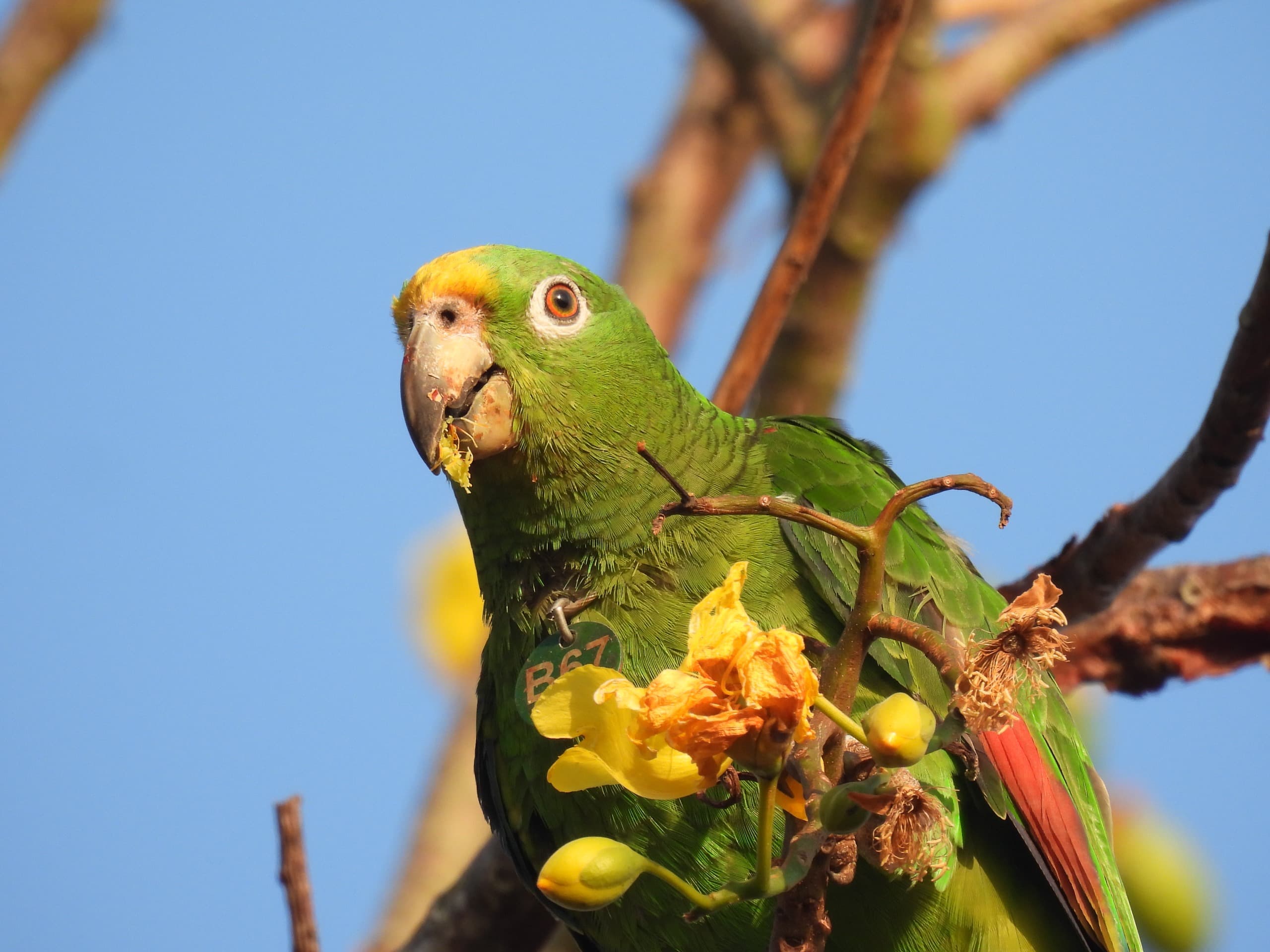
- Olivo (Quadrella odoratissima): a native tree of the dry forest and coastal scrub; macaws tear open its pods, which ripen in the heart of the dry season, to eat the seeds.
- Flowers
- Matarratón (Gliricidia sepium): they consume flowers and also pods (and their seeds)
- Cassia de Siam / Siam Cassia (Senna siamea): they consume flowers (heavily visited when in bloom)
- Roble (Tabebuia sp.)
- Rosa Amarilla (Cochlospermum vitifolium)
3) A "star" tree for fast results: papaya
While many TDF trees take years to produce large harvests or cavities, papaya (Carica papaya) has one major advantage: it grows very fast. Under favorable conditions, it can start producing in around a year — which means a lot of food available in a short time.
In rural landscapes of northern Bolívar (farms, yards, living fences, and forest edges), papaya can be a key resource for attracting and supporting parrots and macaws while the long-term native trees establish and mature.
4) "Dual-purpose" trees (the best short list)
If someone asks for a short list of "the best" trees because they serve as shelter + food and perform well in the dry Caribbean:
- Ceiba bonga (Ceiba pentandra)
- Ceiba de leche / jabillo (Hura crepitans)
- Camajorú / camajón (Sterculia apetala)
- Orejero (Enterolobium cyclocarpum)
- Palma de vino (Attalea butyracea)
- Caracolí (Anacardium excelsum)
- Guásimo (Guazuma ulmifolia)
- Jobo (Spondias mombin)
- Ciruela costeña (Spondias purpurea)
- Matarratón (Gliricidia sepium) (for flowers/pods and productive value)
- Almendro de playa (Terminalia catappa) (for seeds and availability) — note: not native to the tropical dry forest, but grows very fast.
- Papaya (Carica papaya) (for high use and fast production)
5) Notes for farmers (trees that help birds and the farm)
In cattle farming systems in northern Bolívar, some species are a win-win: they help maintain food for birds and improve the pasture.
-
Matarratón (Gliricidia sepium)
-
Birds: consume flowers and pods (with their seeds).
-
Livestock farming: excellent as a living fence, provides shade, has forage uses under management, and supports silvopastoral systems.
-
-
Guásimo (Guazuma ulmifolia)
-
Birds: consume fruits.
-
Livestock farming: provides shade and is highly valued for its hardiness in dry climates.
-
6) The golden rule in Tropical Dry Forest
For parrots and macaws to return and stay, what works is a combination:
-
species that provide fast, frequent food (for example papaya (Carica papaya), mango (Mangifera indica), jobo (Spondias mombin), ciruela (Spondias purpurea), guásimo (Guazuma ulmifolia), tamarindo (Tamarindus indica)),
-
and species that support life over the long term as shelter trees (for example ceiba bonga (Ceiba pentandra), jabillo (Hura crepitans), camajorú (Sterculia apetala), orejero (Enterolobium cyclocarpum), palma de vino (Attalea butyracea)).
Videos: parrots and macaws feeding in the wild (Fundación Loros)
To see real examples of these species feeding in the Colombian Caribbean, visit this Fundación Loros YouTube playlist showing parrots feeding in the wild.
Open review
Reviews of this article
This text gets corrected with input from the field. You can review the whole article below, or scroll back up and flag a specific paragraph while you read. We read every submission before publishing it.
This article has no published reviews yet. If something you read contradicts your experience, misses a nuance, or you can add to it from your own fieldwork, write it here: we read all of it.
Leave your review
You can review the whole article from here, or flag a specific paragraph while you read.